Category: All About Newton

News, events, children’s activities in Newton, MA.

  • World Premiere of 9-Man with Director Ursula Liang!

    World Premiere of 9-Man with Director Ursula Liang!

    9-MAN WORLD PREMIERE

    Independent Film Festival Boston
    Sunday April 27th, 1pm
    Somerville Theatre, main screen
    55 Davis Square
    Advance tickets ($1 cheaper)


    The Chinese Historical Society of New England and the Boston Asian American Film Festival/AARW host a special reception in Davis Square following the screening at the Somerville Theatre, part of the Independent Film Festival of Boston.

    To purchase tickets, please go here.

    Questions, email info@chsne.org or call 617.338.4339

    Come celebrate the World Premiere of 9-Man with Director Ursula Liang!

  • Kids Cooking Class with ChopChop Cookbook at Wellesley Book Store

    Kids Cooking Class with ChopChop Cookbook at Wellesley Book Store

    Kids Cooking Class with ChopChop Cookbook at Wellesley Book Store

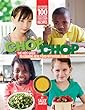
    ChopChop Magazine Editor Sally Sampson has expanded the boundaries of her kids cooking magazine with a new cookbook: CHOPCHOP: The Kids’ Guide to Cooking Real Food with Your Family. Complete with family-favorite recipes from the magazine plus dozens of new recipes, the ChopChop cookbook redefines what it means to cook and eat healthily by bringing kids and adults together on exciting projects in the kitchen. The event will demonstrate how to make delicious yogurt parfaits at home.

    There will be two cooking classes:
    2:30 pm: Ages 5-8
    3:30 pm: Ages 9-12

    ABOUT THE AUTHOR
    Sally Sampson is the founder of ChopChop magazine and the author and coauthor of numerous cookbooks, including the James Beard Award-nominated The $50 Dinner Party, Throw Me a Bone, and The Olives Table. She has contributed to Self, Bon Appétit, Food & Wine, The Atlantic, The Boston Globe, and The Boston Phoenix. She lives with her family in Watertown, Massachusetts.

    Go here to sign up.

    cooking class book event for kids Wellesley book store

  • WSJ: The Mickey Rooney Role Nobody Wants to Talk Much About

    WSJ: The Mickey Rooney Role Nobody Wants to Talk Much About

    Paramount, the studio behind “Breakfast” has now acknowledged Yunioshi as such a toxic caricature that its canonical “Centennial Collection” DVD release of the film includes a companion documentary, “Mr. Yunioshi: An Asian Perspective,” which features Asian American performers and advocates in conversation about the role’s lasting cultural impact and the broader context of Asian and other racial stereotypes in entertainment.

    “In the decades since the film was released, Rooney’s portrayal of Yunioshi — taped eyelids, buck teeth, sibilant accent and all — has become one of the persistent icons of ethnic stereotype, brought up whenever conversation turns to the topic of Hollywood racism. The depiction has prompted widespread protests whenever the film is screened; Paramount, the studio behind “Breakfast at Tiffany’s” has now acknowledged Yunioshi as such a toxic caricature that its canonical “Centennial Collection” DVD release of the film includes a companion documentary, “Mr. Yunioshi: An Asian Perspective,” which features Asian American performers and advocates in conversation about the role’s lasting cultural impact and the broader context of Asian and other racial stereotypes in entertainment.

    The Mickey Rooney Role Nobody Wants to Talk Much About

    Mickey Rooney in ‘Breakfast at Tiffany’s’, 1961 Everett 

    Six years ago, after four decades of stolidly defending the role, even Rooney himself finally expressed some regrets, stating in an interview that if he’d known so many people would be offended, “I wouldn’t have done it.”

    Would that he hadn’t. The spectre of Yunioshi continues to haunt Hollywood and Asian America today. Rooney’s broadly comic performance, repurposed from his early vaudeville days into the brave new world of the cinema, is the godfather of the “Ching-Chong” stereotype that continues to rear its yellow head today — as the recent “Colbert Report” flap underscores. Though I wasn’t a supporter of the tactics or stated objectives of the #CancelColbert campaign, the point made by the activists behind it is a valid one: Racially stereotypical images are problematic even when presented as progressive satire, because many who see them won’t understand the context and will laugh for the “wrong reasons.”

    And even when laughed at for the right reasons, they’re problematic. As many have pointed out in the wake of that campaign, the mainstreaming of these images has the unfortunate side effect of making them seem safe for public consumption…so long as their intent isn’t to “harm.””

    From The Wall Street Journal. The entire article here.

    These are all related posts on Thoroughly Modern Millie at Newton North High School:

    My Take on Thoroughly Modern Millie

    Talk Back: Racism in Thoroughly Modern Millie at NNHS

    NNHS Responds to Concerns About Thoroughly Modern Millie

    MTI Advises How to Squelch Dissent on Thoroughly Modern Millie

    Throwndown NNHS: Talk the Talk or Walk the Walk? Regarding Racism in Thoroughly Modern Millie

    Rebuttal to ‘Millie in Newton: Turn Stereotypes into Lessons

    More Than 50% of Asian American Teens are Bullied in School

    White Privilege and Thoroughly Modern Millie

    Thoroughly Modern Millie End of School Year Takeaway

    Thoroughly Modern Millie Talk Back Videos

    These are other articles and posts related to Thoroughly Modern Millie at Newton North High School:

    The Boston Globe: School Play’s Stereotypes Bring Outcry and Apology. “Millie” touches nerve in Newton by Ellen Ishkanian

    The Boston Globe: ‘Millie’ Flag Highlights How Old Plays are Rife with Stereotypes by Don Aucoin

    The Telegraph: US high school show triggers race row by David Millward

    NECN TV SegmentNECN Broadside with Jim Braude, Historical Musical Sparks Controvery at Massachusetts High School

    The Boston Globe: ‘Millie’ Fight Creates a Chilling Effect by Joan Vennochi

    The Boston Globe: ‘Millie’ in Newton: Turn Stereotypes into Lessons

    The Boston Globe: Musical is Little More Than Staged Racism by Jeffrey Melnick (Letter to Editor in response to Joan Vennochi’s article above).

    Monitoring, Exposing & Fighting Against Anti-Semitism and Racism: Thoroughly Modern Millie’ play draws controversy in Mass. over racial stereotyping

    Company One: In the Intersection, Thoroughly Modern Millie Controvery at Local High School

    A case study published by UMass Peter Kiang almost 20 years ago (see pages 9-13), parallels almost exactly what happened at Newton North High School. ScholarWorks at UMass Boston, We Could Shape It: Organizing for Asian American Student Empowerment by Peter Nien-Chu Kiang.

    The Notebook: Racism isn’t entertainment: Why “Thoroughly Modern Millie” didn’t belong on CAPA’s stage

    Resist Racism: Thoroughly Racist ‘Thoroughly Modern Millie’

    Genki Speak: Racism in Our Backyard

    Angry Asian Man

    Village 14: Decision to Stage ‘Thoroughly Modern Millie’ at North Challenged

    AsAm News: Play Filled With Offensive Images Sparks Town Hall Meeting

    AsAm News: I Love Newton: High School Production Fails To Address Heavy Dose Of Asian American Stereotypes

    Greer Tan Swiston: Kudos to Newton North for a thoroughly modern update of ‘Millie’

    The Boston Globe: Oh, by the way, how about a round of applause for the kids? (Letter to the Editor from a grandparent)

    The Boston Globe: Choice, execution of musical informed by thoughful education process (Letter to the Editor from the writers who comprise the Theatre Arts Opportunity Committee at Newton North High School.)

    The Boston Globe: We miss a vital chance for understanding when we swap out ethnic characters(Letter to the Editor from a great-grandmother, teacher and volunteer)

    Arissa Oh ‏@arissaoh  1h

    3 white ppl on @GreaterBoston unhelpfully discuss HS prodns of “Thoroughly Modern Millie.” cc: @pragmaticmom

    Pawprint: Millard West Student NewspaperThrough with Thoroughly Modern Millie

    The Washington PostTwenty-Three Skiddo: ‘Modern Millie’ Doesn’t Dance

    It’s an attempt, sort of, at a parody of the old-style musicals of the ’20s and ’30s, the sort jerry-built out of cheerful songs, convoluted plots, elaborate tap demonstrations and derogatory stereotypes.

    IMDbThoroughly Embalmed Musical

    Project MuseThoroughly Modern Millie (review)

    Not Like CrazyAn Easily Overlooked Racism?

    In the Spring semester at school, the Musical Theater Department put on Thoroughly Modern Millie, which was overflowing with racism in its portrayal of Asians. I must say, I was thoroughly upset about the whole thing. First, the guys playing the Asians, I believe they were supposed to be Chinese immigrants, had white face makeup and slanty eyes. I couldn’t help but think that if they’d dressed in blackface, surely there’d be an uproar (Of course, they are putting on Ragtime this year, so we’ll see how they handle that– they’re already sending out emails about how they want the black students to try out for roles because there aren’t many black people in the musical theater department *eyeroll*). That wasn’t the only bad thing about the musical, however, the villian was a white woman pretending to be Asian who pronounced her L’s as R’s, and said she used soy sauce to clean a stain. Of course, she also treated the two Asian immigrants who worked for her as if they were stupid, and the silently and humbly submit in front of her, though behind closed doors they argue in Chinese (I guess it was real Chinese), with subtitles projected above the stage. And then one of the Asian men falls in love with one of the white women in the musical, blonde hair, blue eyes, you know the deal. At the end of the musical, they get together, as if his reward for working hard and being submissive, for being mistreated, is the gift of white womanhood, the pinnacle of creation. So yeah, I was pretty pissed about that whole thing.

    MyvanwyReview of Thoroughly Modern Millie

    Someone sent me video of a local comedian’s youtube video of a character I’ve seen him portray once before. To call it infantile and racially insensitive would be a gross understatement. For the targets of his ridicule, it’s every bit as offensive as a mean-spirited performance in blackface. But because it’s against one of the few groups for whom bigotry, hostility, and ridicule is still acceptable (Chinese Americans and others of Asian and/or Pacific Island descent), it’s seen as okay by most and even encouraged by other local comedians. Kevin Marshall’s America

    Zak KeithHollywood Asian Stereotypes

    Racism against Asians is often “unawares”—a form of racism that flies under the radar due to its widespread acceptance as the norm. Its interactive dynamic resembles that of an unwritten social contract. Asians in the West are expected to accept patronizing remarks and racist taunts so demeaning that perpetrators would think twice before dishing them out with such unwavering consistency to any other minority group, such as Latinos or African Americans. Asians who object to such treatment are typically met with befuddlement and offense at their audacity to make an issue out of it.

    p.p.s. Here are some related posts on my Asian American blog:

    How Asian Americans Are Portrayed in U.S. Media. Who Should Be the Next Asian Old Spice Guy?

    Asian Americans in Recurring TV Gigs

    A Racist Bakesale Exposes Reverse Discrimination Against Asian Americans (I include this link because this is the real racist front that Asian Americans are currently fighting. All my posts on this topic are here.

    Making us explain why Yellow Face is offensive is a waste of our time. I can’t believe this is still being used. In real life, has there ever been a white person pretending to be Asian? It’s only in the media and on the stage that this ridiculous premise exists.)

    Survivor: Cook Islands Winner Yul Kwon and Why Media Portrayal of Asian Americans Matters

    miasmall

    Mia Wenjen blogs at PragmaticMom: Education Matters, here and occasionally at her Asian American blog JadeLuckClub. She resides in Newton with her husband and three kids, the oldest of which will attend Newton North High School this fall. She can be found on PinterestTwitter, LinkedIn, Facebook, Sulia, Google +Instagram and YouTube.

    Photo credit: Grasshopper and Sensei, my oldest.

  • 200 Volunteers Needed for Peirce Community Playground Build!

    200 Volunteers Needed for Peirce Community Playground Build!

    Earlier this school year, the Peirce elementary school community came together to raise funds to build a much needed new playground at their school.

    Their current playground has begun to rot and Newton Parks and Recreation has reported that it will soon be unsafe for play.

    The new playground, which will be assembled over the course of two days – Saturday, May 17 and Sunday, May 18 – will require the effort of 200 volunteers.

    If you are interested in helping Peirce assemble their new playground, you can visit peirceplayground.comto learn more about the project and to sign up for a shift.

    We need to secure 40-60 volunteers for each shift throughout the day on Saturday, May 17 and Sunday, May 18.

    Peirce Elementary School playground build

    Please note:
    All volunteers must be at least 18 years old. No children will be allowed anywhere on Peirce property on Build Days.

    No skills or experience required. There is a job for everyone!

    Bring friends, grandparents or non-Peirce neighbors to join with you for a shift (share the link above or sign them up directly).

    Visit www.peirceplayground.com for additional information about the Community Build and what to expect.

    Peirce Elementary School Newton new playground

  • Thoroughly Racist ‘Thoroughly Modern Millie’

    Thoroughly Racist ‘Thoroughly Modern Millie’

    Thoroughly Racist ‘Thoroughly Modern Millie’

    from Resist racism and eat your carrots

    Posted on  by 

     Why does the white version of anti-racism rely on committing racist acts and then using them as “teachable moments”?  If I want to teach students about violence, I don’t punch them and then tell them it’s wrong.  If I teach trauma surgery, I don’t first run over somebody with a car.


    Thanks to Mia Wenjen for covering this topic so thoroughly on her blog, I Love Newton.

    “Thoroughly Modern Millie” was a musical film from 1967.  It included a subplot about a hotel proprietor who dresses in yellowface and two nefarious Chinese henchmen.  It was developed into a musical 33 years later, and the racist subplot remained intact.

    I was somewhat surprised that anybody would consider a remake of a dated movie to be a good idea, especially given the racism.  Of course, we’re only too familiar that white people find agreat deal of entertainment in racism.  The entertainment value is often used as a defense of racism:  “But it was only meant in good fun!”

    If you do a brief web search, you’ll find that “Thoroughly Modern Millie” is a popular choice for high school theatrical groups.  Undoubtedly because it’s so much fun.  Newton North High School chose it for its spring production.  Newton (MA) is predominately (82%) white, with an 11% Asian American population.  And although concerns were voiced before the musical was staged, it proceeded as planned.  Although a note about the “stereotypes” was listed in the program guide, apparently.  On page 49.

    It’s been my general experience that when white people are confronted with their racism, they rarely will completely abandon the racist endeavor.  This is because they have too much invested in both the endeavor and the racism.


    A friend of mine once said that white people won’t admit to racist actions because they don’t like being wrong.  I think that’s right, but I think it’s more than that.  Part of it is that they have been conditioned to believe that their viewpoint is always right, and this is regularly reinforced until it completely supplants any type of critical thinking.  Part of it is because the racist viewpoint is the infrastructure that supports institutionalized racism.

    One of the most common responses in discussions of racism is minimization.  “Oh, it’s not a big deal.”  Because we’re making a mountain out of a molehill.  Yet if you turn it around, it suddenly becomes a big deal.  If it isn’t such a big deal to perpetuate racist stereotypes, then it shouldn’t be such a big deal not to do it.

    But it is a big deal.  And this is privilege.

    Because we’ve found again and again that white people will fight for their right to maintain racist structures.

    “It’s just a silly musical.”  However, this selection of a musical served to make it quite clear who should and should not be engaging in the theater production.  People who knew this was all in good fun?  In!  People who are whiners and who see racism in everything?  Out!

    So basically what Newton North High School did was create a whites-only musical without ever having to call it such.

    Oh, but when white people want to show you how open and inclusive they are, they’ll include that little note on page 49.  Although that note will go largely unnoticed by the audience.  Although that note rings completely false when you have a character in yellowface and two Oriental buffoons for laughs.  Because white people want to eat their cake and have it too.

    And then they will congratulate themselves.  Here’s the principal, Jennifer Price, quoted in theBoston Globe:

    Newton North principal Jennifer Price said Monday that administrators have learned through the experience and stressed that the school in no way condones racism.

    “We can say very clearly, it is not what Newton North believes in,” she said. “We very much at this school are so proud of the diversity. It defines us.”

    Because if you say you are not racist, it must be true!  Because anti-racism is all about thinking warm fuzzy thoughts and singing kumbaya.  It doesn’t have anything to do with confronting established systems of power or being made to feel uncomfortable or about having to cancel a stupid musical because it is racist.  It’s just about what you believe.

    Here’s a novel thought:  If you don’t want to be thought of as racist, don’t do racist things. 

    The harm goes beyond preventing certain people from participating in the theater group.  It perpetuates the image of the “Chinaman” as somebody subhuman and fair game for ridicule.  And dehumanizing others makes it easier to treat them as less than.

    This is especially toxic and alarming in a school environment.  Asian Americans suffer significant amounts of bullying in the classroom (.pdf link) and Asian American teenaged girls suffer from the highest rate of depressive symptoms of any racial or ethnic group.  Suicide is the fifth leading cause of death among Asian Americans (source).  And racism is a significant stressor for all people of color and has negative ramifications on health and well-being.

    So when white people ask “what’s the harm?” you can point to actual statistics.

    After the school and the theater group chose to perform this racist musical, the principal, the theater director and the FPA chair then wrote a long self-aggrandizing letter talking about everything that had been done (none of which, of course, included cancelling the performance).  They talked to the kids, they put a program note on page 49, and they tried to find out if there was a “high school edition,” which they claim does not exist.  (Note:  MTI does in fact offer a “Jr.” version of this musical, but it doesn’t seem to omit racism.  So no idea what is being kept from high school students here.)

    They also talked about the opportunities they have to “learn and grow.”

    I’ve said it before and I’ll say it again:  Why does the white version of anti-racism rely on committing racist acts and then using them as “teachable moments”?  If I want to teach students about violence, I don’t punch them and then tell them it’s wrong.  If I teach trauma surgery, I don’t first run over somebody with a car.

    So you can talk all you want about your awareness of stereotypes and your anti-racism.  But if you go ahead and produce a racist musical, you’ve already shown me what you really believe.

    There are about a million teachable moments about racism every day, and I can’t say that I’ve ever noticed any of my white teachers using them to teach.  Rather, I think it’s fair to say that many, many racist events happen in the school settings where teachers and administrators minimize or deny or ignore.  It’s the same shit over and over again, and partly because it is continually re-taught and re-enacted.  High schools around the country perform “Thoroughly Modern Millie” and elementary schools everywhere still have kids dress up like Indians for Thanksgiving.

    So performing “Thoroughly Modern Millie” isn’t just about excluding a significant portion of the population, but additionally is about recreating and repopularizing racist entertainment.  IT WAS A 1967 MOVIE, FOR FUCK’S SAKE!  LET THE FUCKER DIE ALREADY!

    I’d note that this is a clear argument against that false belief that “racism will die out as old people die out.”  Because obviously racism is being taught to the new generations.

    Another faulty argument that often arises in defense of racism is the “history” one.  You know, because you can’t erase the past.  Another Boston Globe writer sums it up thusly:

    Adults should remember that art reflects reality at a given moment in time. And while the past can be uncomfortable to recall, it’s better for the next generation to learn from it rather than forget about it.

    This is frankly an idiotic argument, and one that points to a gross lack of critical thinking.  Because we aren’t talking about removing all copies of the movie “Thoroughly Modern Millie” from existence.  We’re talking about not performing racism.  I don’t think the next generation is going to forget about racism.  Because it’s being carefully taught on a daily basis.

    There’s also the Free speech! argument, which I’ve covered plenty.  But people of color, don’t forget that the free speech argument doesn’t apply to you.  Because the institution supported by racism will always seek to silence you in whatever way possible.

    Mia Wenjen posted a transcription of much of the Asian American testimony at the Talk Back, which was held after the musical concluded.  While there are a fair number of comments thanking her for raising the issue, there are a number that took issue with what she said.  Particularly what she said about two unnamed persons whom she referred to as “white privilege husband” and “white privilege wife.”

    This is “white privilege husband”:

    His point was that there were racist stereotypes in a lot of  musicals and works of literature and that this was ok. When Michele Leong  responded, she waited for him to reply. There was a long pause.

    Why? He had been texting on his phone the entire time, not listening and not realizing that, in fact, this Michele was speaking to him.

    “White privilege wife” said, “We are not here to support you [the Asian Americans]” when Wenjen greeted her.

    One of the commenters claims to be the daughter of “white privilege wife” and uses 400+ words to talk about how great her mother is and how she has dedicated her life to helping small children or crack users or something.  She demands an apology, all because Wenjen reported her mother said “We are not here to support you [the Asian Americans].”

    Another claims to be the son of “white privilege husband” and an actor in the musical.  He must have written a thousand words or so, part of them supporting the goodness of “white privilege wife” and part talking about what a wonderful human being he is.

    And then he goes to the “tone” argument.

    Yeah, we have heard it all before.

    But I’m not sure we have “valuable allies” when our “allies” are busily writing more about how great they are.  Because anti-racism with a white center will never work.  Because trying to dictate how we proceed in social justice work is an attempt to control and often to silence.  You can read it in the high school students’ comments.  They are attempting to silence and to shame.  Because white teens undoubtedly know more about racism than an adult Asian American woman who has lived the Asian American experience.

    Because they are being carefully taught.  Because that is one of the costs of racism.
    racism in Thoroughly Modern Millie

    My Posts:

    Thoroughly Modern Millie is Thoroughly Racist

    My Take on Thoroughly Modern Millie

    Talk Back: Racism in Thoroughly Modern Millie at NNHS

    NNHS Responds to Concerns About Thoroughly Modern Millie

    MTI Advises How to Squelch Dissent on Thoroughly Modern Millie

    Throwndown NNHS: Talk the Talk or Walk the Walk? Regarding Racism in Thoroughly Modern Millie

    Rebuttal to ’Millie in Newton: Turn Stereotypes into Lessons

    More Than 50% of Asian American Teens are Bullied in School

    White Privilege and Thoroughly Modern Millie

    Thoroughly Modern Millie End of School Year Takeaway


    Other Links:

    The Boston Globe: School Play’s Stereotypes Bring Outcry and Apology. “Millie” touches nerve in Newton by Ellen Ishkanian

    The Boston Globe: ‘Millie’ Flag Highlights How Old Plays are Rife with Stereotypes by Don Aucoin

    The Telegraph: US high school show triggers race row by David Millward

    NECN TV SegmentNECN Broadside with Jim Braude, Historical Musical Sparks Controvery at Massa chusetts High School

    The Boston Globe: ‘Millie’ Fight Creates a Chilling Effect by Joan Vennochi

    The Boston Globe: ‘Millie’ in Newton: Turn Stereotypes into Lessons

    The Boston Globe: Musical is Little More Than Staged Racism by Jeffrey Melnick (Letter to Editor in response to Joan Vennochi’s article above).

    Monitoring, Exposing & Fighting Against Anti-Semitism and Racism: Thoroughly Modern Millie’ play draws controversy in Mass. over racial stereotyping

    Company One: In the Intersection, Thoroughly Modern Millie Controvery at Local High School

    A case study published by UMass Peter Kiang almost 20 years ago (see pages 9-13), parallels almost exactly what happened at Newton North High School. ScholarWorks at UMass Boston, We Could Shape It: Organizing for Asian American Student Empowerment by Peter Nien-Chu Kiang.

    The Notebook: Racism isn’t entertainment: Why “Thoroughly Modern Millie” didn’t belong on CAPA’s stage

    Resist Racism: Thoroughly Racist ‘Thoroughly Modern Millie’

    Genki Speak: Racism in Our Backyard

    Angry Asian Man

    Village 14: Decision to Stage ‘Thoroughly Modern Millie’ at North Challenged

    AsAm News: Play Filled With Offensive Images Sparks Town Hall Meeting

    AsAm News: I Love Newton: High School Production Fails To Address Heavy Dose Of Asian American Stereotypes

    Greer Tan Swiston: Kudos to Newton North for a thoroughly modern update of ‘Millie’

    The Boston Globe: Oh, by the way, how about a round of applause for the kids? (Letter to the Editor from a grandparent)

    The Boston Globe: Choice, execution of musical informed by thoughful education process (Letter to the Editor from the writers who comprise the Theatre Arts Opportunity Committee at Newton North High School.)

    The Boston Globe: We miss a vital chance for understanding when we swap out ethnic characters (Letter to the Editor from a great-grandmother, teacher and volunteer)

    Arissa Oh ‏@arissaoh  1h

    3 white ppl on @GreaterBoston unhelpfully discuss HS prodns of “Thoroughly Modern Millie.” cc: @pragmaticmom

    Pawprint: Millard West Student NewspaperThrough with Thoroughly Modern Millie

    The Washington PostTwenty-Three Skiddo: ‘Modern Millie’ Doesn’t Dance

    It’s an attempt, sort of, at a parody of the old-style musicals of the ’20s and ’30s, the sort jerry-built out of cheerful songs, convoluted plots, elaborate tap demonstrations and derogatory stereotypes.

    IMDbThoroughly Embalmed Musical

    Project MuseThoroughly Modern Millie (review)

    Not Like Crazy: An Easily Overlooked Racism?

    In the Spring semester at school, the Musical Theater Department put on Thoroughly Modern Millie, which was overflowing with racism in its portrayal of Asians. I must say, I was thoroughly upset about the whole thing. First, the guys playing the Asians, I believe they were supposed to be Chinese immigrants, had white face makeup and slanty eyes. I couldn’t help but think that if they’d dressed in blackface, surely there’d be an uproar (Of course, they are putting on Ragtime this year, so we’ll see how they handle that– they’re already sending out emails about how they want the black students to try out for roles because there aren’t many black people in the musical theater department *eyeroll*). That wasn’t the only bad thing about the musical, however, the villian was a white woman pretending to be Asian who pronounced her L’s as R’s, and said she used soy sauce to clean a stain. Of course, she also treated the two Asian immigrants who worked for her as if they were stupid, and the silently and humbly submit in front of her, though behind closed doors they argue in Chinese (I guess it was real Chinese), with subtitles projected above the stage. And then one of the Asian men falls in love with one of the white women in the musical, blonde hair, blue eyes, you know the deal. At the end of the musical, they get together, as if his reward for working hard and being submissive, for being mistreated, is the gift of white womanhood, the pinnacle of creation. So yeah, I was pretty pissed about that whole thing.

    MyvanwyReview of Thoroughly Modern Millie

    Someone sent me video of a local comedian’s youtube video of a character I’ve seen him portray once before. To call it infantile and racially insensitive would be a gross understatement. For the targets of his ridicule, it’s every bit as offensive as a mean-spirited performance in blackface. But because it’s against one of the few groups for whom bigotry, hostility, and ridicule is still acceptable (Chinese Americans and others of Asian and/or Pacific Island descent), it’s seen as okay by most and even encouraged by other local comedians. Kevin Marshall’s America

    Zak KeithHollywood Asian Stereotypes

    Racism against Asians is often “unawares”—a form of racism that flies under the radar due to its widespread acceptance as the norm. Its interactive dynamic resembles that of an unwritten social contract. Asians in the West are expected to accept patronizing remarks and racist taunts so demeaning that perpetrators would think twice before dishing them out with such unwavering consistency to any other minority group, such as Latinos or African Americans. Asians who object to such treatment are typically met with befuddlement and offense at their audacity to make an issue out of it.


  • Promise Tomorrow

    Brendan Duggan and Michael Garfinkle composed “Promise Tomorrow” in memory of their classmate and friend Roee Grutman, 17, who in February became the third teenager in Newton to commit suicide this school year.

    “Sat there for hours and I swear I didn’t move

    What to say what to think — it was all in my head

    Hundred thousand different thoughts laid right on my bed

    As my mind starts to think — was it something I said?”

    The lyrics also flowed like never before for Garfinkle:

    “It’s sad to see my friend’s heart break,

    ’Cause that heart break turns to heartache

    Some stop living life too soon, but for those who start late

    It’s never too late to start.”

    Duggan and Garfinkle set their lyrics to a sample by MbSound of the Beatles’ “A Day In The Life.” The video was directed and edited by Alexi Reibman, a junior at Newton North. From The Boston Globe

  • Hair Wars: The Politics of Hair ‘YOU CAN TOUCH MY HAIR’ Exhibit

    I’m Asian American and I’ve never really given that much thought to my hair … except that one time. I was on the swim team in high school in Southern California and my hair, from being outdoors in a chemically treated pool three hours a day, bleached out from solid black to dark, dark brown with red highlights. I thought the red streaks were kind of pretty until my swim team female friends ridiculed it saying that I had “Mexican” red streaked hair.

    Believe me — in Southern California — this was not a compliment.

    Hair as politics. Hmm…

    I pulled the Top 10 Black Models in Fashion. Anyone who’s ever had a subscription to Vogue will know these lovelies.

    Top black fashion models throughout the years prove that beauty has no boundaries. As fashion guru Franca Sozzani, Italian Vogue Editor-in-Chief, says, “the truth is that real beauty doesn’t care for skin color or nationality.”
    And yet, let’s check out their hair.
    1. Iman
    Iman
    2. Naomi Campbell
    She now has bald patches from years of wearing weaves.
    Naomi Campbell
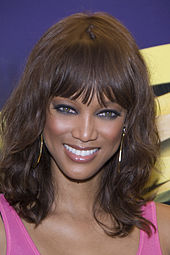
    3. Tyra Banks
    Tyra Banks
    4. Liya Kebede
    Liya Kebede
    5. Chanel Iman
    Liya Kebede
    6. Kimora Lee Simmons

    Kimora Lee Simmons

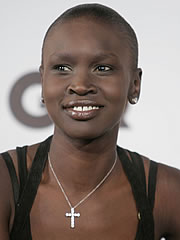
    7. Alek Wek

    Alek Wek

    8. Jessica White

    Jessica White

    9. Sessilee Lopez

    Sessilee Lopez
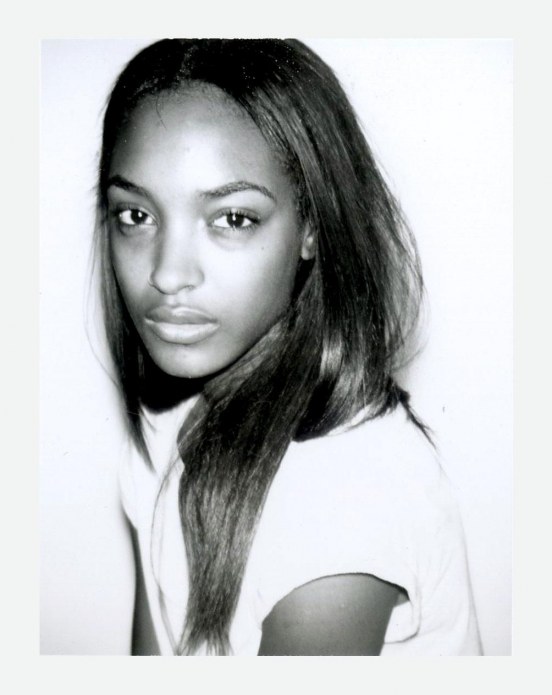
    10. Jourdan Dunn

    jourdan-912336874

    Are there famous African Americans women with natural hair and are they not just as beautiful as the women above?

    Model Yasmin Warsame

    Yasmin Warsame

    Singer, songwriter and model Solange Knowles

    Solange Knowles

    Model Ajak Deng

    Ajak Deng

    Actress Tracey Ellis Ross

    Tracee Ellis Ross

    Singer Erykah Badu

    Erykah Badu

    Singer Janelle Monae

    Janelle Monae

    Actress Viola Davis

    Viola Davis

    We called “You Can Touch My Hair” an exhibit for a reason. We could easily have called it a discussion, or just an event. We could’ve held up signs that said, “Ask me about my hair.” But, we called it “You Can Touch My Hair” for a reason. It wasn’t supposed to make anyone comfortable. But, we wanted to draw the parallel between a very literal display and the not-so-literal displays that happen in everyday life. There’s nothing wrong with being curious, but we do have to be aware of how we let our curiosities play out, and how we’re treating people as a result of them.

    Transcript of video:

    All things black. All things black, here. So we’re here to…

    OK, cool. Is that like a big thing? People would wanna touch your hair?

    Yeah.

    That’s a thing?

    Definitely.

    Weird. Yeah. Cool.

    So, where do you wanna touch?

    You wanna touch my hair? I’m losing some, but…

    You’re losing hair?

    I’ll touch your hair.

    Educate me, and then when you say you can touch my hair, people know what it is they’re actually touching. But if you’re just doing it, and you don’t know the concept behind, you don’t know the origin, you don’t know how it happens, or even how hard it is to take it, then you’ve not been educated. You’ve just had your whatever satisfied.

    With the fascination, and reach and touch my hair, and something else goes down. So, like I said, we’re trying to save some lives out here. You might not wanna just go up to any random black woman and touch their hair, just because other people want you to touch theirs.

    I have — I have happy hair, and I call it happy hair because it is unmolested. I don’t try to make it … I don’t fight it. I have a relationship with my hair. Not always. I’ve grown to this, and I’ve learned, particularly with black American women, most of us are taught, or start off, with the understanding that something is wrong with our hair. Whether it’s our grandmothers wrestling us to the ground to tame it into ponytails, there’s pain and crying and suffering and most people who are, who do our hair, their first lesson is to change it.

    So, we kinda — it’s kinda like Adam and Eve — it’s like Eve, you start off wrong. Like, so for a lot of black American women, our hair, historically, has started off as wrong, and anyone who touches it, their first job is to change it. Change the texture. Change its nature. And so, when you start that way, the journey to finding happiness can be long.

    Well, see, this is the challenge. Black people look — so many black people don’t even know their own hair grade. I’ve had friends in their 30’s look at me and be like, “Oh my gosh, guess what? I cut my hair, and guess what it does?” Because they were so young, myself included, when their hairs were permed, that they didn’t know what their hair looked like. So, when they actually got exposed to it, they were– we actually had to learn our hair in our 20’s and 30’s. We had to figure out how to tend to our hair.

    I was so used to that kind of, you know, media, and what black women’s hair should look like. It should be straight, you know what I mean? So I wasn’t used to that. I had — it took a lot of soul-searching to get used to the texture that I had and be OK with it.

    Because society doesn’t cater to kinky hair. It doesn’t cater to me being able to walk around with my own hair grade. It tells me that it’s not beautiful. It tells me that I’m not as beautiful as a woman of another race. It tells me to wear a weave. It tells me to wear braids. And it tells me, when I do those things, I immediately become more socially acceptable.

    Now that people are starting to embrace it, everyone’s so curious, and they’re so fascinated, and they’re like, “Wow, you’re wearing your hair natural. That’s so different.”

    I was actually at a Helen Hardy, which is similar to like a deli.

    There was a moment, most recently, when I had locks, and I was in line at a coffee shop…

    And I was waiting for my boss to finish paying, and a man who was staring at me the entire time in line, and I just thought he was just a relatively like nice person …

    And I heard two women discussing if they could touch my hair. They didn’t ask me directly, but I overheard them. They were standing directly behind me.

    And he made a beeline for me as I was just waiting by the door, and I guess he felt like we had some type of connection, because I went to go say hi to him, and his hand just like immediately just like went straight for my skull.

    And they were, you know, saying, “Oh, what do you think, if we touched her hair, do you think she would mind if we touched her hair? What if I just put my hands in her hair?”

    That was definitely eye-opening.

    And, you know, I was a little … I was appalled. And so, I slightly turned around, to indicate that I could hear their conversation, and also to let them know, no, do not touch my hair.

    Uh, I was definitely taken aback.

    It felt invasive. It felt as if I was this, you know, curiosity.

    I’ve never had somebody just– well, at that time in my life– I’d never had somebody come up to me and just throw their hand in my head, and not to mention, like, get all the way to my root. It kinda made me feel a little bit vulnerable.

    It made me feel, you know, like, you know, something about me was so totally odd and strange, you know, that it was, you know, OK for them, one, to just come up and touch it, or OK, or two, just to have this conversation behind my back about it.

    But, at the same time, it was … it made me laugh. It’s ballsy, so hats off to him.

    Curious, lack of information, entitlement, no home training?

    I think– I think he was curious. And, again, I feel that he thought he was… he was comfortable enough to actually, you know, ask me, and really go for the gusto. So, I just really think it comes down to curiosity.

    I’m not– I’m not interested in having a conversation where I make people feel better about my hair, or they finally get to learn what my hair texture feels like. Have an intimate relationship with a black person– do you have a black friend? Have an intimate relationship with a black person. You can ask them.

    It’s funny because they were saying that we need to …

    Yeah, that we need to control, or we can help assuage people’s …

    We can control, by saying, no, you cannot. You finally have the voice. We’re not sour. We did not have that option …

    One of the biggest criticisms of the “You Can Touch My Hair” exhibit was it reminded people of a woman named Sarah “Saartjie” Baartman. Sarah Baartman was an African woman, who in the early 1800s was encouraged to go to Europe, only to, literally, be put on display. The Europeans of that time hadn’t seen anyone that looked like her, because she was physically different. So, she was a curiosity. Something– something strange.

    Fast forward to today, and yet again, we have people curious about a physical difference. Yes, curiosity is the first step to enlightenment, but we have to question the nature of our curiosity. Is it innocent curiosity, and even if it is, was it that same type of curiosity that led to Sarah being put on display?

    We called “You Can Touch My Hair” an exhibit for a reason. We could easily have called it a discussion, or just an event. We could’ve held up signs that said, “Ask me about my hair.” But, we called it “You Can Touch My Hair” for a reason. It wasn’t supposed to make anyone comfortable. But, we wanted to draw the parallel between a very literal display and the not-so-literal displays that happen in everyday life. There’s nothing wrong with being curious, but we do have to be aware of how we let our curiosities play out, and how we’re treating people as a result of them.

    There may be small errors in this transcript.
    This awesome exhibit was put on by the lovely ladies at un’ruly. Found on Chic Rebellion TV.

  • White Privilege and Thoroughly Modern Millie at NNHS

    White Privilege and Thoroughly Modern Millie at NNHS

    White Privilege is having the prevalence and importance of the English language and finding amusement in ridiculing people of colour/immigrants for their accents and their difficulty in speaking a language that is not their native tongue.

    I had a long conversation with Pulizer nominated journalist and New York Times best selling author Mitch Zuckoff. Our dogs are very good friends so I see him at the dog park a lot and we chat as our dogs go crazy wrestling and chasing each other. I value his opinion as journalist, particularly on his take of why Thoroughly Modern Millie at Newton North High School turned into a media frenzy (see links below — it was published in the UK’s largest newspaper and on local TV!).

    His take was simple. He had never heard of Thoroughly Modern Millie (like me) and was surprised to hear that it might have racist stereotypes but had a journalist’s skepticism. He read the articles and posts and concluded that White Privilege was the root cause of how it came to be performed at Newton North High School. His words were simply that “White Privilege is not having to think about consequences for portraying racist stereotypes.”

    And in fact, the committee who selected and approved the musical did seem to be completely devoid of anyone of color. I have to say that this play introduced me to the very term “White Privilege.” And it’s a tricky subject;  those who benefit from it are the least likely to admit that it exists. And even defining it … what is White Privilege is challenging to put into words. So when I found this on this on Thought Catalog, I thought it was helpful.


    18 Things White People Don’t Seem to Understand (Because, White Privilege)

    1. White Privilege is being able to move into a new neighborhood and being fairly sure that your neighbors will be pleasant to you and treat you with respect.

    2. White Privilege is being able to watch a movie, read a book and open the front page of a newspaper and see yourself and your race widely represented and spoken for.

    3. White Privilege is being able to seek legal, financial and medical help without having your race work against you.

    4. White Privilege is living in a world where you are taught that people with your skin tone holds the standard for beauty.

    5. White Privilege is never being told to, “get over slavery”.

    white priviledge

    image from Shutterstock

    6. White Privilege is having the prevalence and importance of the English language and finding amusement in ridiculing people of colour/immigrants for their accents and their difficulty in speaking a language that is not their native tongue.

    7. White Privilege is arrogantly believing that reverse racism actually exists.

    8. White Privilege is being able to stay ignorant to the fact that racial slurs are part of a systematic dehumanization of entire groups of people who are and have historically been subjugated and hated just for being alive.

    9. White Privilege is not having your name turned into an easier-to-say Anglo-Saxon name.

    10. White Privilege is being able to fight racism one day, then ignore it the next.

    11. White privilege is having your words and actions attributed to you as an individual, rather than have them reflect members of your race.

    12. White Privilege is being able to talk about racism without appearing self-serving.

    13. White Privilege is being able to be articulate and well-spoken without people being surprised.

    14. White Privilege is being pulled over or taken aside and knowing that you are not being singled out because of your race/colour.

    15. White Privilege is not having to teach your children to be aware of systematic racism for their own protection.

    16. White Privilege is not having to acknowledge the fact that we live in a system that treat people of colour unfairly politically, socially and economically and choosing, instead, to believe that people of colour are inherently less capable.

    17. White Privilege is not having your people and their culture appropriated, romanticized or eroticized for the gain and pleasure of other white people.

    18. White Privilege is being able to ignore the consequences of race.


    My Posts:

    Thoroughly Modern Millie is Thoroughly Racist

    My Take on Thoroughly Modern Millie

    Talk Back: Racism in Thoroughly Modern Millie at NNHS

    NNHS Responds to Concerns About Thoroughly Modern Millie

    MTI Advises How to Squelch Dissent on Thoroughly Modern Millie

    Throwndown NNHS: Talk the Talk or Walk the Walk? Regarding Racism in Thoroughly Modern Millie

    Rebuttal to ’Millie in Newton: Turn Stereotypes into Lessons

    More Than 50% of Asian American Teens are Bullied in School

    White Privilege and Thoroughly Modern Millie

    Thoroughly Modern Millie End of School Year Takeaway

    Thoroughly Modern Millie Talk Back Videos


    Other Links:

    The Boston Globe: School Play’s Stereotypes Bring Outcry and Apology. “Millie” touches nerve in Newton by Ellen Ishkanian

    The Boston Globe: ‘Millie’ Flag Highlights How Old Plays are Rife with Stereotypes by Don Aucoin

    The Telegraph: US high school show triggers race row by David Millward

    NECN TV SegmentNECN Broadside with Jim Braude, Historical Musical Sparks Controvery at Massachusetts High School

    The Boston Globe: ‘Millie’ Fight Creates a Chilling Effect by Joan Vennochi

    The Boston Globe: ‘Millie’ in Newton: Turn Stereotypes into Lessons

    The Boston Globe: Musical is Little More Than Staged Racism by Jeffrey Melnick (Letter to Editor in response to Joan Vennochi’s article above).

    Monitoring, Exposing & Fighting Against Anti-Semitism and Racism: Thoroughly Modern Millie’ play draws controversy in Mass. over racial stereotyping

    Company One: In the Intersection, Thoroughly Modern Millie Controvery at Local High School

    A case study published by UMass Peter Kiang almost 20 years ago (see pages 9-13), parallels almost exactly what happened at Newton North High School. ScholarWorks at UMass Boston, We Could Shape It: Organizing for Asian American Student Empowerment by Peter Nien-Chu Kiang.

    The Notebook: Racism isn’t entertainment: Why “Thoroughly Modern Millie” didn’t belong on CAPA’s stage

    Resist Racism: Thoroughly Racist ‘Thoroughly Modern Millie’

    Genki Speak: Racism in Our Backyard

    Angry Asian Man

    Village 14: Decision to Stage ‘Thoroughly Modern Millie’ at North Challenged

    AsAm News: Play Filled With Offensive Images Sparks Town Hall Meeting

    AsAm News: I Love Newton: High School Production Fails To Address Heavy Dose Of Asian American Stereotypes

    Greer Tan Swiston: Kudos to Newton North for a thoroughly modern update of ‘Millie’

    The Boston Globe: Oh, by the way, how about a round of applause for the kids? (Letter to the Editor from a grandparent)

    The Boston Globe: Choice, execution of musical informed by thoughful education process (Letter to the Editor from the writers who comprise the Theatre Arts Opportunity Committee at Newton North High School.)

    The Boston Globe: We miss a vital chance for understanding when we swap out ethnic characters (Letter to the Editor from a great-grandmother, teacher and volunteer)

    Arissa Oh ‏@arissaoh  1h

    3 white ppl on @GreaterBoston unhelpfully discuss HS prodns of “Thoroughly Modern Millie.” cc: @pragmaticmom

    Pawprint: Millard West Student NewspaperThrough with Thoroughly Modern Millie

    The Washington PostTwenty-Three Skiddo: ‘Modern Millie’ Doesn’t Dance

    It’s an attempt, sort of, at a parody of the old-style musicals of the ’20s and ’30s, the sort jerry-built out of cheerful songs, convoluted plots, elaborate tap demonstrations and derogatory stereotypes.

    IMDbThoroughly Embalmed Musical

    Project MuseThoroughly Modern Millie (review)

    Not Like Crazy: An Easily Overlooked Racism?

    In the Spring semester at school, the Musical Theater Department put on Thoroughly Modern Millie, which was overflowing with racism in its portrayal of Asians. I must say, I was thoroughly upset about the whole thing. First, the guys playing the Asians, I believe they were supposed to be Chinese immigrants, had white face makeup and slanty eyes. I couldn’t help but think that if they’d dressed in blackface, surely there’d be an uproar (Of course, they are putting on Ragtime this year, so we’ll see how they handle that– they’re already sending out emails about how they want the black students to try out for roles because there aren’t many black people in the musical theater department *eyeroll*). That wasn’t the only bad thing about the musical, however, the villian was a white woman pretending to be Asian who pronounced her L’s as R’s, and said she used soy sauce to clean a stain. Of course, she also treated the two Asian immigrants who worked for her as if they were stupid, and the silently and humbly submit in front of her, though behind closed doors they argue in Chinese (I guess it was real Chinese), with subtitles projected above the stage. And then one of the Asian men falls in love with one of the white women in the musical, blonde hair, blue eyes, you know the deal. At the end of the musical, they get together, as if his reward for working hard and being submissive, for being mistreated, is the gift of white womanhood, the pinnacle of creation. So yeah, I was pretty pissed about that whole thing.

    MyvanwyReview of Thoroughly Modern Millie

    Someone sent me video of a local comedian’s youtube video of a character I’ve seen him portray once before. To call it infantile and racially insensitive would be a gross understatement. For the targets of his ridicule, it’s every bit as offensive as a mean-spirited performance in blackface. But because it’s against one of the few groups for whom bigotry, hostility, and ridicule is still acceptable (Chinese Americans and others of Asian and/or Pacific Island descent), it’s seen as okay by most and even encouraged by other local comedians. Kevin Marshall’s America

    Zak KeithHollywood Asian Stereotypes

    Racism against Asians is often “unawares”—a form of racism that flies under the radar due to its widespread acceptance as the norm. Its interactive dynamic resembles that of an unwritten social contract. Asians in the West are expected to accept patronizing remarks and racist taunts so demeaning that perpetrators would think twice before dishing them out with such unwavering consistency to any other minority group, such as Latinos or African Americans. Asians who object to such treatment are typically met with befuddlement and offense at their audacity to make an issue out of it.

  • Meet Grace Lin at Where The Mountain Meets the Moon Show at NNHS

    Meet Grace Lin at Where The Mountain Meets the Moon Show at NNHS

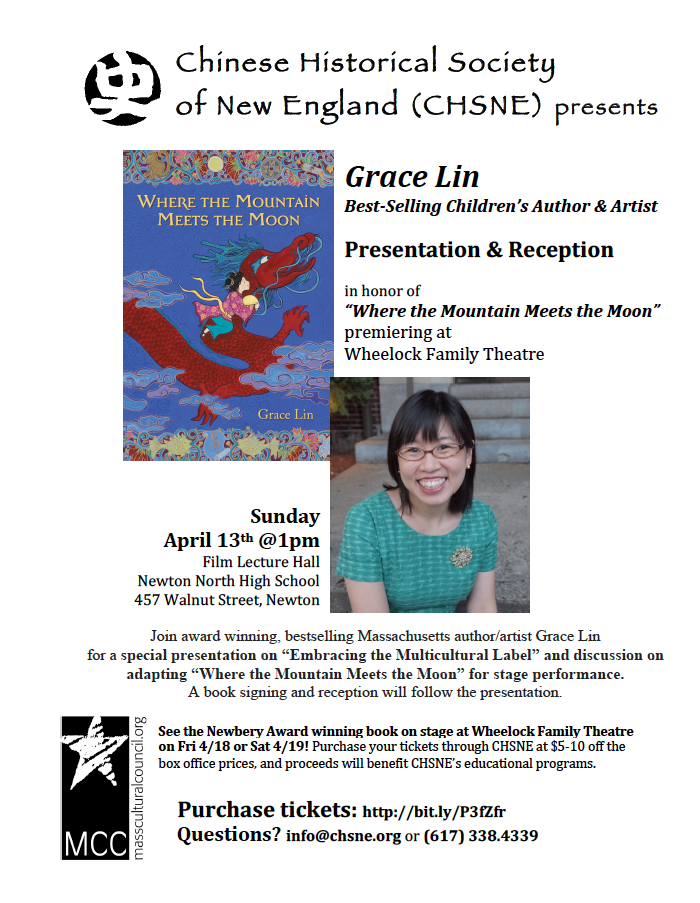
    Chinese Historical Society of New England
    presents
    Grace Lin

    Best-Selling Children’s Author & Artist
    Presentation & Reception
    in honor of
    “Where the Mountain Meets the Moon”

    premiering at Wheelock Family Theatre

    Where The Mountain Meets the Moon play at Wheelock Family Theater

    Sunday, April 13 at 1 pm
    The Film Lecture Hall at Newton North High School
    457 Walnut Street, Newton

    Tickets: $5 for members and $10 for non-membersJoin award-winning, best-selling Massachusetts author/illustrator Grace Lin for a special presentation on “Embracing the Multicultural Label” and discussion on adapting Newbery Award honored book “Where the Mountain Meets the Moon” for stage performance. A book signing (bring your own books, and books will also be available) and reception will follow the presentation.

    Wheelock Family Theatre is presenting “Where the Mountain Meets the Moon” April 11-May 11. The play is adapted from the Newbery Honor Award winning book of the same name, by bestselling author/artist and MA resident Grace Lin!

    Grace Lin Where The Mountain Meets the Moon show at Newton North High School

    Want to see the show at Wheelock Family Theatre?

    Save $5-$10 per ticket by purchasing tickets for the Fri 4/18 and Sat 4/19 shows of “Where the Mountain Meets the Moon” from the Chinese Historical Society of New England and proceeds will benefit the Chinese Historical Society of New England educational programs. (Chinese Historical Society of New England Tickets are $15/mezzanine and $25/orchestra!)

    Download a flyer here.
    Purchase tickets here.

  • More Than Half of Asian American Teens Are Bullied in School

    More Than Half of Asian American Teens Are Bullied in School

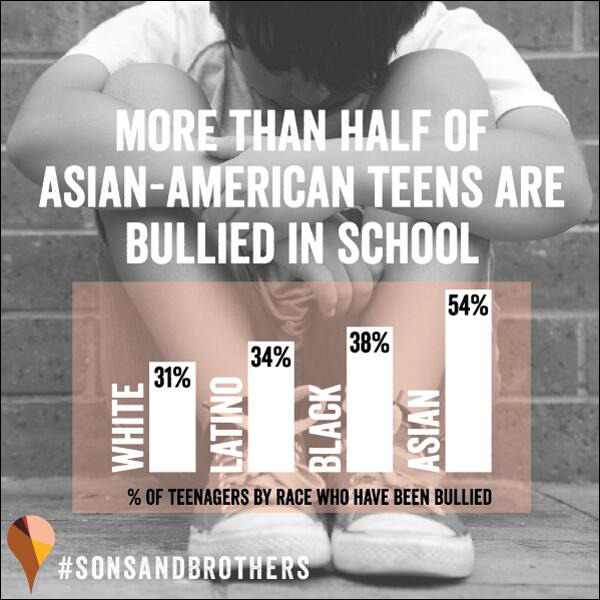
    MORE THAN HALF OF ASIAN AMERICAN TEENS ARE BULLIED IN SCHOOL

    According to survey data released in 2011 by the US Justice Department and Education Department, Asian Americans endure far more bullying in U.S. schools than any other ethnic group, and compared to other teens, Asian American teens are three times as likely to face bullying on the internet.

    A report released last year by the Asian American Legal Defense and Education Fund and The Sikh Coalition revealed that half of all Asian American students surveyed in New York City have been the target of bias-bullying and harassment, mirroring national statistics.

    And according to a report released earlier this month, more than half of Sikh school children are bullied.

    Throw in the scores of stories I’ve posted the years about young Asian Americans who have taken their lives after enduring bullying, violence and harassment in school, and it’s all a stark, powerful reminder that we need continued efforts to confront and combat this issue.

    Stand up and speak out!

    From Angry Asian Man