Kick Start Your College Essay, Thursday, June 29, 7:30 pm, Druker Auditorium: Summer is a great time to start your college essay! Join Jane Hirschhorn of JBH Tutoring to get eleven ways to kick start your essay. We’ll go over excerpts from essays written by students admitted to prestigious colleges. This program is for high schoolers, particularly rising seniors and their parents. Register online.
Conquering the College Admissions Essay in 10 Easy Steps, Wednesday, July 12, 7:00 pm, Druker Auditorium:Join us for a discussion with Alan Gelb, the author of the bestselling, Conquering the College Admissions Essay in 10 Steps. The 3rd edition was recently published in June of this year. Alan coaches students all over the world on their personal statements. He will be conducting a workshop on how to approach this daunting assignment, answering your questions and getting you started writing this summer. For teens and parents.
Strategies for the SAT & ACT Tests, Tuesday, August 1, 7:00 pm, Druker Auditorium: Our SAT vs. ACT seminar is packed with information about the SAT and ACT and the roles they play in college admissions. An expert Princeton Review instructor will cover the content of the tests, walk you through and share some examples of our proven test-taking strategies. Register online.
SAT & ACT Practice Tests, Saturday, August 12 & 19, 10-2 pm, Druker Auditorium: How will you score? Find out by taking full-length SAT and ACT practice tests under realistic testing conditions proctored by the Princeton Review. Try your hand at the types of questions you’ll see on the real tests and get a personalized score report highlighting your strengths and areas of improvement. We’ll be offering this two Saturdays in a row, so you can have the chance to take both tests if you would like, or take one test twice! Register online for August 12 or August 19.
How to Write Great College Essays, Tuesday, August 15, 7:00 pm, Druker Auditorium: A lot of great kids write average college essays—essays about “life lessons learned from football” or “how my trip to Europe broadened my cultural horizons.” Better tales are there for the writing. This workshop will show you what admissions officers really look for in great college essays, and offer suggestions for finding and sharing your best stories. We’ll even share the five most over-used topics you must avoid and give you tips on how to start (and even finish) your essays this summer. Join Abby van Geldern, of Collegewise Newton and former college admissions counselor at RPI, for this great workshop. For teens and adults. Register online.
Energy is in everything. We use energy for everything we do, from making a jump shot to baking cookies to sending astronauts into space.
There are two types of energy:
Stored (potential) energy
Working (kinetic) energy
There is a great iPad/iPhone/iPod Touch app to design roller coasters that shows this.
Coaster Physics. Design your own roller coaster and watch the potential energy convert to kinetic energy as you ride your roller coaster. $.99. My first grader plays this all the time! Click on icon to view at iTunes.
For example, the food you eat contains chemical energy, and your body stores this energy until you use it when you work or play.
Energy Sources Can be Categorized As Renewable or Nonrenewable
When we use electricity in our home, the electrical power was probably generated by burning coal, by a nuclear reaction, or by a hydroelectric plant at a dam. Therefore, coal, nuclear and hydro are called energy sources. When we fill up a gas tank, the source might be petroleum or ethanol made by growing and processing corn.
Energy sources are divided into two groups — renewable (an energy source that can be easily replenished) and nonrenewable (an energy source that we are using up and cannot recreate). Renewable and nonrenewable energy sources can be used to produce secondary energy sources including electricity and hydrogen.
Solar energy from the sun, which can be turned into electricity and heat
Wind
Geothermal energy from heat inside the Earth
Biomass from plants, which includes firewood from trees, ethanol from corn, and biodiesel from vegetable oil
Hydropower from hydroturbines at a dam
Nonrenewable Energy
We get most of our energy from nonrenewable energy sources, which include the fossil fuels — oil, natural gas, and coal. They’re called fossil fuels because they were formed over millions and millions of years by the action of heat from the Earth’s core and pressure from rock and soil on the remains (or “fossils”) of dead plants and creatures like microscopic diatoms. Another nonrenewable energy source is the element uranium, whose atoms we split (through a process called nuclear fission) to create heat and ultimately electricity.
We use renewable and nonrenewable energy sources to generate the electricity we need for our homes, businesses, schools, and factories. Electricity “energizes” our computers, lights, refrigerators, washing machines, and air conditioners, to name only a few uses.
Most of the gasoline used in our cars and motorcycles and the diesel fuel used in our trucks are made from petroleum oil, a nonrenewable resource. Natural gas, used to heat homes, dry clothes, and cook food, is nonrenewable. The propane that fuels our outdoor grills is made from oil and natural gas, both nonrenewable.
The chart above shows what energy sources the United States used in 2010. Nonrenewable energy sources accounted for 92% of all energy used in the Nation. Biomass, the largest renewable source, accounted for over half of all renewable energy and 4% of total energy consumption.
————————-
What is light?
This is from Optical Resources.
What is light?
It’s a kind of energy called “electromagnetic (EM) radiation” (but this kind of radiation is not harmful, except for an occasional sunburn). There are other kinds of EM radiation too (radio waves, microwaves, x-rays, etc.), but light is the part WE can see, the part that makes the rainbow.
How does light travel?
FAST and STRAIGHT.
How FAST?
About 186,000 miles per second [300,000 kilometers per second], so light from the sun takes about 8 minutes to go 93 million miles [149 million kilometers] to earth. Does this seem SLOW? Well, if you could DRIVE to the sun at 60 mph [100 kph], it would take you 177 years to get there! In one second, light can go around the earth 7 times!
How STRAIGHT?
Perfectly straight, until something bends it. The straight paths of light are called LIGHT RAYS.
How are shadows formed?
When light strikes an object, some light reflects (based on the colour of the object). when there is an obstacle in the way of the light, and it cannot pass, there is no light to reflect, and thus a shadow is formed.
A SHADOW IS FORMED WHEN LIGHT SHINES AT AN OPAQUE OBJECT BLOCKING THE LIGHT RAY CAUSING A SHADOW BECAUSE LIGHT ONLY GOES IN A STRAIGHT LINE.
Vocabulary
These are the terms for the 4th Grade Test
translucent versus transparent versus opaque:
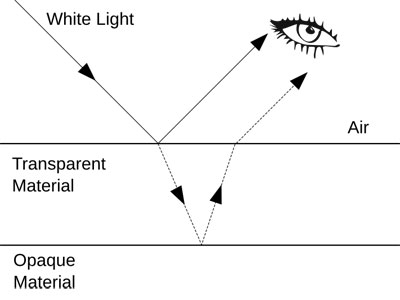
a transparent object is one that lets light pass through (clear window)
a translucent object lets some light go through but not all (bathroom window)
opaque: light can not go through it. Impenetrable by light; neither transparent nor translucent.
an opaque object lets no light pass through (a table)
absorption: The term absorption refers to the physical process of absorbing light. The process in which incident radiated energy is retained without reflection or transmission on passing through a medium. For example, light can not go through an object that is opaque because that object absorbs the light.
The phenomenon of a light beam rebounding after hitting a surface is called reflection. To put it simply, the mirror images are what are called reflection generally. However in the case of refraction, these angles are not the same. Different media participate in refraction, thus making this angle unequal. Reflection is found in mirrors while lenses use refraction.
light energy: energy transferred by radiation, especially by an electromagnetic wave. It’s a kind of energy called “electromagnetic (EM) radiation” (but this kind of radiation is not harmful, except for an occasional sunburn). There are other kinds of EM radiation too (radio waves, microwaves, x-rays, etc.), but light is the part WE can see, the part that makes the rainbow.
When a light wave with a single frequency strikes an object, a number of things could happen. The light wave could be absorbed by the object, in which case its energy is converted to heat. The light wave could be reflected by the object. And the light wave could be transmitted by the object.
sound energy: Sound is a type of energy made by vibrations. When any object vibrates, it causes movement in the air particles. These particles bump into the particles close to them, which makes them vibrate too causing them to bump into more air particles. This movement, called sound waves, keeps going until they run out of energy. If your ear is within range of the vibrations, you hear the sound.
pitch: pitch is the frequency at which an object vibrates to create a sound. A tuning fork, for example, that vibrates 440 times a second will produce a perfect “A” note. It is these predetermined levels of frequencies that pitch is categorized into the twelve chromatic musical tones.
vibrate: move back and forth rapidly.
Did you hear that sound? It was made by air vibrating. The same is true for sounds made by musical instruments. The difference between NOISE and MUSIC is that musical sounds are organized into patterns that have pitch and rhythm. Noise is just random, disorganized sounds. Sounds are made and travel in the same way whether they are musical sounds or noise.
A musical sound is called a tone, and is produced by air vibrating a certain number of times per second. These vibrations are called waves.
What is sound? Sound is a form of energy, just like electricity and light. Sound is made when air molecules vibrate and move in a pattern called waves, or sound waves. Think of when you clap your hands, or when you slam the car door shut. That action produces soundwaves, which travel to your ears and then to your brain, which says, “I recognize that sound.”
Sound is a type of energy made by vibrations. When any object vibrates, it causes movement in the air particles. These particles bump into the particles close to them, which makes them vibrate too causing them to bump into more air particles. This movement, called sound waves, keeps going until they run out of energy. If your ear is within range of the vibrations, you hear the sound.
Picture a stone thrown into a still body of water. The rings of waves expand indefinitely. The same is true with sound. Irregular repeating sound waves create noise, while regular repeating waves produce musical notes.
When the vibrations are fast, you hear a high note. When the vibrations are slow, it creates a low note. The sound waves in the diagram show the different frequencies for high and low notes.
Low frequency notes
High frequency notes
How do Wind Instruments make sound?
In wind instruments, like the flute and trumpet, vibrating air makes the sound. The air particles move back and forth creating sound waves. Blowing across a flute’s blow hole sets up Slinky-like waves in the tube. In the clarinet, a vibrating reed (a thin piece of wood set in the mouthpiece) gets the waves started. Different pitches are played by pressing keys that open or close holes in the tube making the air column inside the tube longer or shorter. Longer air columns produce lower pitches.
How do String Instruments make sound?
Stringed instruments are played by pressing the fingers down on the strings. This pressure changes the strings’ length, causing them to vibrate at different frequencies and making different sounds. Shortening a string makes it sound higher. Strings produce different sounds depending on their thickness.
Energy makes change possible. We use it to do things for us. It moves cars along the road and boats over the water. It bakes a cake in the oven and keeps ice frozen in the freezer. It plays our favorite songs on the radio and lights our homes. Energy is needed for our bodies to grow and it allows our minds to think.
Scientists define energy as the ability to do work. Modern civilization is possible because we have learned how to change energy from one form to another and use it to do work for us and to live more comfortably.
Forms of Energy
Energy is found in different forms including light, heat, chemical, and motion. There are many forms of energy, but they can all be put into two categories: potential and kinetic.
Potential Energy
Potential energy is stored energy and the energy of position — gravitational energy. There are several forms of potential energy.
Kinetic Energy
Kinetic energy is motion — of waves, electrons, atoms, molecules, substances, and objects.
Chemical Energy is energy stored in the bonds of atoms and molecules. Batteries, biomass, petroleum, natural gas, and coal are examples of stored chemical energy. Chemical energy is converted to thermal energy when we burn wood in a fireplace or burn gasoline in a car’s engine.Mechanical Energy is energy stored in objects by tension. Compressed springs and stretched rubber bands are examples of stored mechanical energy.Nuclear Energy is energy stored in the nucleus of an atom — the energy that holds the nucleus together. Very large amounts of energy can be released when the nuclei are combined or split apart. Nuclear power plants split the nuclei of uranium atoms in a process called fission. The sun combines the nuclei of hydrogen atoms in a process called fusion.Gravitational Energy is energy stored in an object’s height. The higher and heavier the object, the more gravitational energy is stored. When you ride a bicycle down a steep hill and pick up speed, the gravitational energy is being converted to motion energy. Hydropower is another example of gravitational energy, where the dam “piles” up water from a river into a reservoir.
Radiant Energy is electromagnetic energy that travels in transverse waves. Radiant energy includes visible light, x-rays, gamma rays and radio waves. Light is one type of radiant energy. Sunshine is radiant energy, which provides the fuel and warmth that make life on Earth possible.Thermal Energy, or heat, is the vibration and movement of the atoms and molecules within substances. As an object is heated up, its atoms and molecules move and collide faster. Geothermal energy is the thermal energy in the Earth.Motion Energy is energy stored in the movement of objects. The faster they move, the more energyis stored. It takes energy to get an object moving, and energy is released when an object slows down. Wind is an example of motion energy. A dramatic example of motion is a car crash, when the car comes to a total stop and releases all its motion energy at once in an uncontrolled instant.Sound is the movement of energy through substances in longitudinal (compression/rarefaction) waves. Sound is produced when a force causes an object or substance to vibrate — the energy is transferred through the substance in a wave. Typically, the energy in sound is far less than other forms of energy.Electrical Energy is delivered by tiny charged particles called electrons, typically moving through a wire. Lightning is an example of electrical energy in nature, so powerful that it is not confined to a wire.
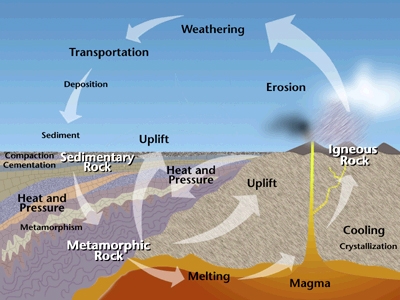
The Rock Cycle via video for Igneous Rock, Sedimentary Rock and Metamorphic Rock
These are the concepts that my kids find confusing, so I’ve added some extra information from sites to help kids understand the differences. This great information is from Mr.SciGuy.
Erosion versus Weathering
This is from Compare Anything.
Weathering and erosion are geological processes that act together to shape the surface of the Earth.
Erosion is displacement of solids (soil, mud, rock and other particles) usually by the agents of currents such as, wind, water, or ice by downward or down-slope movement in response to gravity or by living organisms.
Weathering is the decomposition of rocks, soils and their minerals through direct contact with the Earth’s atmosphere.
This video shows weathering verus erosion through some great demonstrations. It’s 9 minutes long.
This is a confusing concept, so here’s more:
What’s the difference between weathering and erosion?
Weathering involves two processes that often work in concert to decompose rocks. Both processes occur in place. No movement is involved in weathering. Chemical weathering involves a chemical change in at least some of the minerals within a rock. Mechanical weathering involves physically breaking rocks into fragments without changing the chemical make-up of the minerals within it. It’s important to keep in mind that weathering is a surface or near-surface process. As you know, metamorphism also produces chemical changes in rocks, but metamorphic chemical changes occur at depth where either the temperature and/or pressure are significantly higher than conditions found on the Earth’s surface.
As soon as a rock particle (loosened by one of the two weathering processes) moves, we call it erosion or mass wasting. Mass wasting is simply movement down slope due to gravity. Rock falls, slumps, and debris flows are all examples of mass wasting. We call it erosion if the rock particle is moved by some flowing agent such as air, water or ice.
So, here it is: if a particle is loosened, chemically or mechanically, but stays put, call it weathering. Once the particle starts moving, call it erosion.
This is from The National Park Service.
Here’s a fun video from Scholastic:
—————–
Rock versus Minerals
The Museum of Science does a great school classroom presentation called Rock Detectives. One great example they gave of rocks versus minerals is this:
Chocolate Chip Cookie
What ingredients are used to make a chocolate chip cookie? Kids will answer with things like: flour, butter, sugar and chocolate chips.
The chocolate chip cookie is LIKE A ROCK made up of ingredients. Ingredients are LIKE MINERALS.
What happens if instead of baking, you fry it instead? You get … chocolate chip pancakes. So, depending on what happens to the mix of minerals (for example, different pressures and/or heat), there are different outcomes. JUST LIKE minerals and rocks.
Rocks
A rock is a mixture of one or more minerals. They are classified by the way that they are made.
A mineral is
Naturally occurring
Inorganic
Definite chemical composition & crystalline structure
Solid
Mineral Identification Tests
The Color Test- easiest test to do but not always reliable
The Streak Test
The color of the powdered mineral.
Performed by rubbing the unknown mineral on an unglazed tile.
The Luster Test
the way a mineral shines or doesn’t shine
the only way to really learn the different lusters is to see them for yourself.
Types of Luster
Metallic– looks like shiney metal
Non-metallic– all the other ways that a mineral can shine
Glassy/vitreous– shines like a piece of broken glass (most common non-metallic)
Dull/earthy– no shine at all
Resinous/waxy- looks like a piece of plastic or dried glue
Pearly– looks oily it may have a slight rainbow like an oil slick on water. Also looks like the inside of some clam shells
Adamantine– brilliant, sparkling shine like a diamond
Hardness– a minerals resistance to scratching. This should not be confused with brittleness. A diamond is very hard and will scratch a hammer but a hammer will smash a diamond. Likewise, talc, one of the softest minerals, is not squishy. It will still put a serious hurting on you if you get hit in the head with it.
This awesome chart is for sale here. Includes all 6 crystal classes and presents the physical properties: hardness, habit, luster, cleavage, specific gravity, color, fluorescence, and streak.
——————–
Types of Rocks
Igneous Rocks
“Fire Formed”– melted rock material cools and solidifies (“freezing”)
Intrusive– rock formed inside the Earth
Extrusive– rock formed on the surface
Texture– the size of the crystals- NOT HOW IT FEELS
Sedimentary Rocks
Made from sediments or rock material that has been broken down in some way.
Sedimentary rocks are usually formed in a watery environment.
Often layered
Are the only rocks that normally contain fossils
Metamorphic Rocks
changed from a pre-existing rock
caused by extreme heat and/or pressure
—————–
Cleavage versus Fracture
Cleavage -To break along flat surfaces.
Examples of Cleavage (these examples are not on the test but I think they are helpful to illustrate cleavage visually).
Cubic– To break into cubes
Rhombihedral– to break into “pushed over cubes”
Basal– to split into thin sheets
Fracture -The way a mineral without cleavage breaks.
Examples of Fracture (This is not on the test, but it might help your child get a visual sense of a fracture — think bowl shape, needs, or sharp edges).
conchoidal– to break in a scooped out bowl shape- like a conch (sea snail)
hackly fracture– to have irregular sharp edges
splintery– to break into long, thin needles
—————-
This is not on the test, but here are more details on rocks versus minerals to help your child solidify this concept. This is from Rocks For Kids.
ROCKS
All rocks are made of 2 or more minerals, but minerals are not made of rocks.
Rock Words:There are many common names for rocks and the usually give you an idea of how big the rock is. Here are a few:
mountain – huge, giant hunk of rock that is still attached to the earth’s crust, doesn’t move, tall
boulder – large, taller than a person
rock – large, you could get your arms around it or a bit smaller but it is usually jagged,
broken off a bigger piece of rock
river rock – round rocks that are along the edge & at the bottom of fast-flowing rivers
stone – medium, you could hold it in two hands
pebble – small, you can hold it with two fingers, could get stuck in your shoe, usually rounded
sand – made up of tiny pieces of rock, grains of sand
grain – tiny, like a grain of rice or smaller, often found on a beach
dust – really fine powder that is mixed in with sand or soil
speck – as in a speck of dirt
MINERALS
A mineral is the same all the way through. That is one reason we speak of
a sample or a specimen rather than a rock.
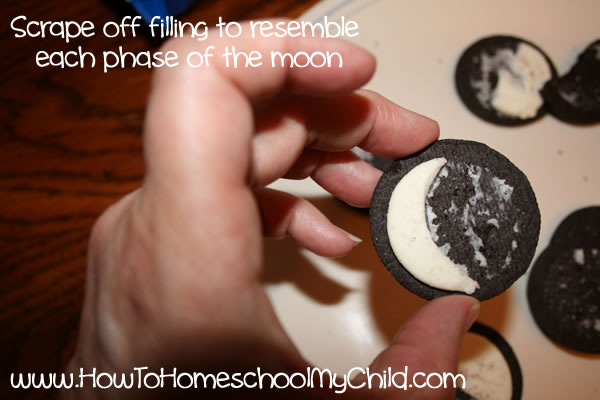
My kids study phases of the moon in 4th grade and both girls seemed to have problems with getting Waxing versus Waning straight in their heads despite a week of study. It could be that Waxing Crescent Moons look pretty similar to Waning Crescent Moons. I think Oreos would help with this!
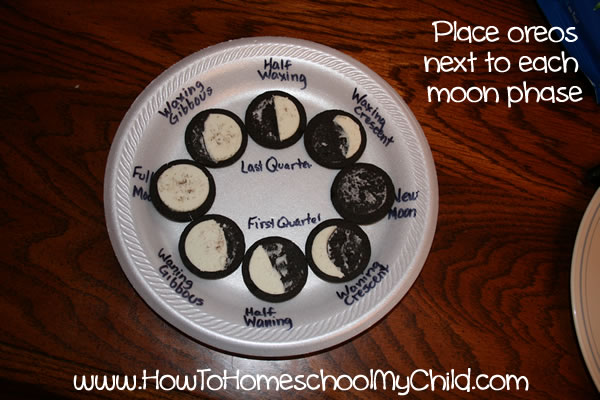
I have a fun moon project that a Dad Friend first did for my oldest when she was in preschool. Clearly, it didn’t sink in but perhaps repetition is key. I’d use the mini-oreos myself for creating a cookie based phases of the moon chart. If you want to try it, it’s below.
Some kids might need a more detailed explanation and I found this from Moon Connection.
Other kids might like a video.
Diagram Explanation
The illustration may look a little complex at first, but it’s easy to explain.
Sunlight is shown coming in from the right. The earth, of course, is at the center of the diagram. The moon is shown at 8 key stages during its revolution around the earth. The moon phase name is shown alongside the image. The dotted line from the earth to the moon represents your line of sight when looking at the moon. To help you visualize how the moon would appear at that point in the cycle, you can look at the larger moon image. This means for the waning gibbous, third quarter, and waning crescent phases you have to mentally turn yourself upside down. When you do this, you’ll “see” that the illuminated portion is on your left, just as you see in the large image.
One important thing to notice is that exactly one half of the moon is always illuminated by the sun. Of course that is perfectly logical, but you need to visualize it in order to understand the phases. At certain times we see both the sunlit portion and the shadowed portion — and that creates the various moon phase shapes we are all familiar with. Also note that the shadowed part of the moon is invisible to the naked eye; in the diagram above, it is only shown for clarification purposes.
So the basic explanation is that the lunar phases are created by changing angles (relative positions) of the earth, the moon and the sun, as the moon orbits the earth.
If you’d like to examine the phases of the moon more closely, via computer software, you may be interested in this moon phases calendar software.
Moon Phases Simplified
It’s probably easiest to understand the moon cycle in this order: new moon and full moon, first quarter and third quarter, and the phases in between.
As shown in the above diagram, the new moon occurs when the moon is positioned between the earth and sun. The three objects are in approximate alignment (why “approximate” is explained below). The entire illuminated portion of the moon is on the back side of the moon, the half that we cannot see.
At a full moon, the earth, moon, and sun are in approximate alignment, just as the new moon, but the moon is on the opposite side of the earth, so the entire sunlit part of the moon is facing us. The shadowed portion is entirely hidden from view.
The first quarter and third quarter moons (both often called a “half moon“), happen when the moon is at a 90 degree angle with respect to the earth and sun. So we are seeing exactly half of the moon illuminated and half in shadow.
Once you understand those four key moon phases, the phases between should be fairly easy to visualize, as the illuminated portion gradually transitions between them.
An easy way to remember and understand those “between” lunar phase names is by breaking out and defining 4 words: crescent, gibbous, waxing, and waning. The word crescent refers to the phases where the moon is less that half illuminated. The word gibbous refers to phases where the moon is more than half illuminated. Waxing essentially means “growing” or expanding in illumination, and waning means “shrinking” or decreasing in illumination.
Thus you can simply combine the two words to create the phase name, as follows:
After the new moon, the sunlit portion is increasing, but less than half, so it is waxing crescent. After the first quarter, the sunlit portion is still increasing, but now it is more than half, so it is waxing gibbous. After the full moon (maximum illumination), the light continually decreases. So the waning gibbous phase occurs next. Following the third quarter is the waning crescent, which wanes until the light is completely gone — a new moon.
The Moon’s Orbit
You may have personally observed that the moon goes through a complete moon phases cycle in about one month. That’s true, but it’s not exactly one month. The synodic period or lunation is exactly 29.5305882 days. It’s the time required for the moon to move to the same position (same phase) as seen by an observer on earth. If you were to view the moon cycling the earth from outside our solar system (the viewpoint of the stars), the time required is 27.3217 days, roughly two days less. This figure is called the sidereal period or orbital period. Why is the synodic period different from the sidereal period? The short answer is because on earth, we are viewing the moon from a moving platform: during the moon cycle, the earth has moved approximately one month along its year-long orbit around the sun, altering our angle of view with respect to the moon, and thus altering the phase. The earth’s orbital direction is such that it lengthens the period for earthbound observers.
Although the synodic and sidereal periods are exact numbers, the moon phase can’t be precisely calculated by simple division of days because the moon’s motion (orbital speed and position) is affected and perturbed by various forces of different strengths. Hence, complex equations are used to determine the exact position and phase of the moon at any given point in time.
Also, looking at the diagram (and imagining it to scale), you may have wondered why, at a new moon, the moon doesn’t block the sun, and at a full moon, why the earth doesn’t block sunlight from reaching the moon. The reason is because the moon’s orbit about the earth is about 5 degrees off from the earth-sun orbital plane.
However, at special times during the year, the earth, moon, and sun do in fact “line up”. When the moon blocks the sun or a part of it, it’s called a solar eclipse, and it can only happen during the new moon phase. When the earth casts a shadow on the moon, it’s called a lunar eclipse, and can only happen during the full moon phase. Roughly 4 to 7 eclipses happen in any given year, but most of them minor or “partial” eclipses. Major lunar or solar eclipses are relatively uncommon.
Obviously, you’ll need a package of Oreos. Each child will need 8 Oreos, a butter knife and a paper plate. You may need more than 8 Oreos if they crack on you. You can use the mini Oreos too.
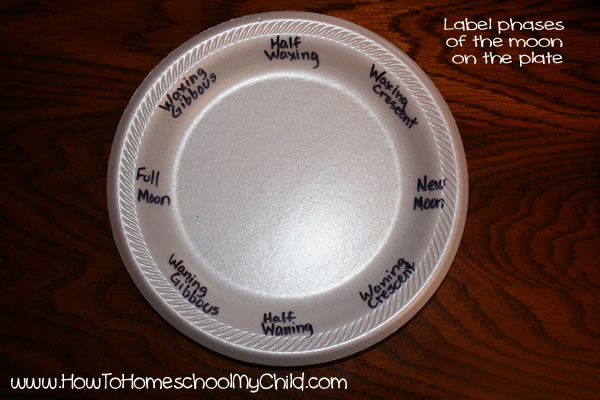
Depending on the age of your child, let them use a Sharpie to label each phase on the paper plate.
Be very careful as you separate your Oreos.
I had a few crack, so I had to eat them. Gosh!
The full moon & new moon are already done when you pull apart your Oreo.
It may take practice, but each child needs to scrape off the filling to create 2 crescent moons, 2 half moons and 2 ginnous moons.
I just saw the Museum of Science of Boston’s presentation on weather for 5th graders today and I remembered how difficult it was for me to help my fifth grader figure out how to study for her weather unit. I spent hours googling weather terminology to help her with flashcards but then, trying to put together all the casual relationships was confusing, even to me.
While that weather presentation was fresh in my head, I thought I’d capture it and have also added links and video to help kids really understand these concepts.
p.s. I was pre-med in college so I never actually studied the weather. Please leave a comment to add to this or to make corrections. Especially you, George, from the Museum of Science. Thank you! Also leave questions if anything is confusing and I’ll keep adding to this.
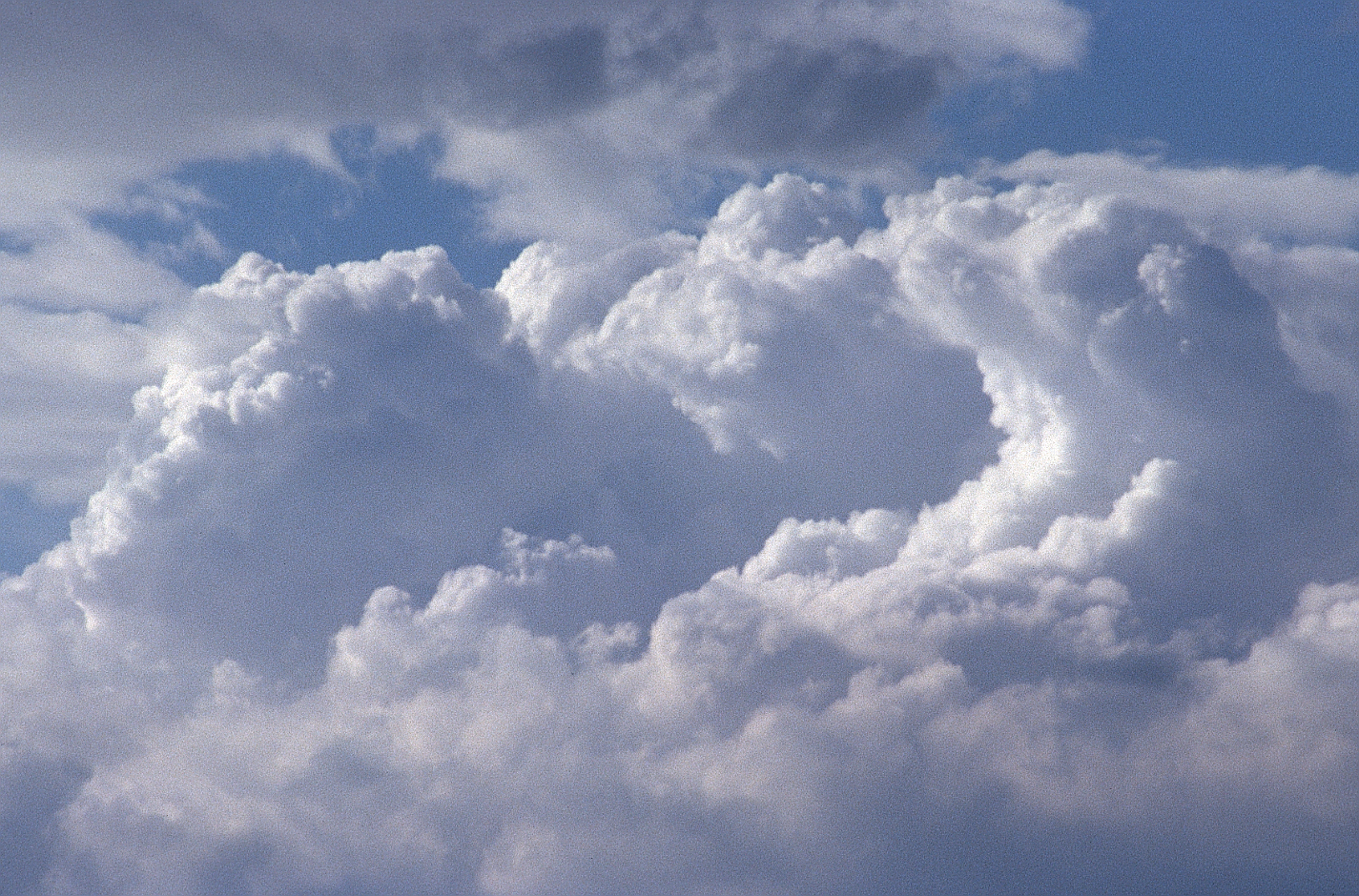
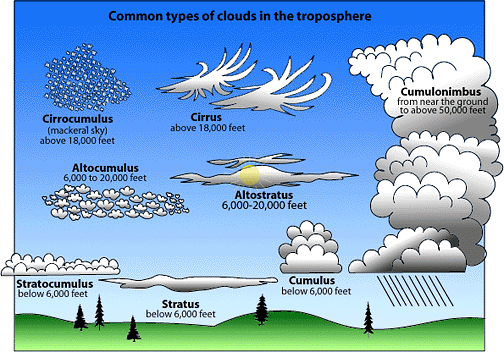
p.p.s. I am adding a great post by Doodles and Jots about Clouds. She has cloud photos, cloud types diagram, & companion art project.
What Causes Weather: Heat, Air Pressure, Wind and Moisture
Heat: is from our sun. The light energy from the sun converts to heat energy when it hits the earth.
The tilt of the planet affects how much heat an area on the planet receives and this is also why we have seasons. Because the earth is sphere, when it is tilted the light energy in the middle of the planet is spread out a smaller distance than the top or the bottom (depending on angle of the tilt). The same light energy which converts to heat energy upon hitting the earth means less heat for a larger area versus a smaller area. [see link for explantory video]
Air pressure: is the weight of the Earth’s atmosphere pressing down on everything at the surface. Explaining Air pressure video from The Weather Channel. Watch to learn how air pressure is caused by heat (more heat is less pressure because molecules spread out so air rises, and less heat makes molecules squish together so pressure falls.)
The relationship between air pressure and heat. Cold air is more dense (has a greater weight per unit volume) than warm air. If the air is unconfined and heated — as would be the circumstances in the atmosphere — the density of the gas decreases (i.e. gets lighter). This is because the molecules in the air spread out when heated, causing air pressure to decrease. Think of a hot air balloon. Heating the air causes the air balloon rise because the heated air is lighter than the colder air around it.
The relationship between air pressure and weather. Air has weight, and a barometer measures the changes in air pressure above. When a high-pressure area is in control, the air sinks. Sinking air inhibits the development of clouds. When the air sinks, more force pushes down toward the ground, so the barometric pressure increases. Conversely, when a low-pressure area moves in, the air rises, cools and condenses out moisture, which forms clouds and precipitation. Since a rising column of air above weighs less, the air pressure falls.
As the sun heats the ground or ocean, warning them, the air near the ground or ocean warms and becomes less dense. As this happens the air begins rising, which lowers the air pressure at the Earth’s surface.
Very cold air, on the other hand, can create large areas of high pressure because cold air is more dense (heavier) than warm air. The Earth’s highest surface air pressures are found in masses of very cold air over places such as Siberia.
The relationship between air pressure and wind. Air pressure and wind speed are related: as air pressure drops, wind speed increases.
Wind: is air in motion. It is produced by the uneven heating of the earth’s surface by the sun. See video below to learn how changes in air pressure from high to low pressure cause wind.
Moisture: water can exist in three different states: solid, liquid, and vapor.
Water droplets form from warm air. As the warm air rises in the sky it cools. Water vapor (invisible water in the air) always exists in our air. Warm air holds quite a bit of water. For example, in the summer it is usually very humid. When enough of these droplets collect together, we see them as clouds. If the clouds are big enough and have enough water droplets, the droplets bang together and form even bigger drops. When the drops get heavy, they fall because of gravity, and you see and feel rain.
A cloud is a large collection of very tiny droplets of water or ice crystals. The droplets are so small and light that they can float in the air.
How are Clouds Formed? All air contains water, but near the ground it is usually in the form of an invisible gas called water vapor. When warm air rises, it expands and cools. Cool air can’t hold as much water vapor as warm air, so some of the vapor condenses onto tiny pieces of dust that are floating in the air and forms a tiny droplet around each dust particle. When billions of these droplets come together they become a visible cloud.
Humidity: is the amount of moisture in the air. The relative humidity is the amount of moisture in the air as a percentage of the most moisture that could be in the air at a certain temperature. If the air has half the amount of moisture it could have then the relative humidity is 50%.
Dewpoint: Another popular expression of humidity is the dewpoint. This is the temperature that the relative humidity will be 100% when air is cooled. When air cools the relative humidity will increase. It will continue to increase as the air cools until it reaching the saturation point. Morning dew is common in humid places in the morning. This occurs from air cooling to the dewpoint and further cooling results in condensation.
Climate versus Weather
Mountains and Climate: The temperature on mountains becomes colder the higher the altitude gets. Mountains tend to have much wetter climates than the surrounding flat land.
Oceans and Climate: the ocean responds very slowly to changes in the seasons, causing it to have a moderating effect on climate (i.e. water is harder to heat or cool than land so it affects the weather around it). The sea makes winters in coastal regions a bit warmer and summers near the coast a bit cooler than they are farther inland. . Notice how coastal cities have milder winters and more pleasant summers.
On a smaller scale, the sun heats up land faster than nearby water, causing the air over land to begin rising sooner than air over the ocean. As rising air over the land creates lower air pressure, cooler air from over the ocean flows in to replace it, creating a sea breeze.
Climate versus Weather: The difference between weather and climate is a measure of time. Weather is what conditions of the atmosphere are over a short period of time, and climate is how the atmosphere “behaves” over relatively long periods of time.
More Terms
Barometer: A barometer measures atmospheric pressure.
Barometric Pressure: another term for air pressure or atmospheric pressure. Air pressure is also called barometric pressure because barometers are used to measure it.
Atmospheric Pressure: or air pressure is the force exerted on you by the weight of tiny particles of air (air molecules).
Molecule: Molecules are small particles that make up all living and non-living things. They are made up of even tinier particles called atoms.
Temperature: Temperature is a degree of hotness or coldness the can be measured using a thermometer. It’s also a measure of how fast the atoms and molecules of a substance are moving. Temperature is measured in degrees on the Fahrenheit, Celsius, and Kelvin scales.