Category: All About Newton

News, events, children’s activities in Newton, MA.

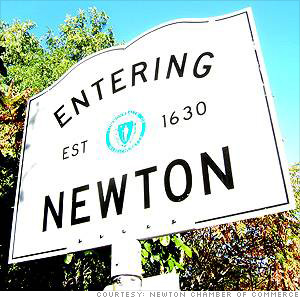
  • Newton Ranks #21: Best Cities to Live In

    Newton Ranks #21: Best Cities to Live In

    A host of factors play an important role in deciding where to move, including the quality of schools, the strength of the local economy and job market, safety, culture, and even climate.

    To determine America’s best cities to live in, 24/7 Wall St. reviewed data on the 550 U.S. cities with populations of 65,000 or more as measured by the U.S. Census Bureau. Based on a range of variables, including crime rates, employment growth, access to restaurants and attractions, educational attainment, and housing affordability, 24/7 Wall St. identified America’s 50 Best Cities to Live.

    21. Newton, Massachusetts
    > Population: 88,809
    > Median home value: $809,700
    > Poverty rate: 4.3%
    > Pct. with at least a bachelor’s degree: 76.6%

    More than three-quarters of adults in Newton have at least a bachelor’s degree, high even compared with Massachusetts as a whole — the state’s over 40% college attainment rate is the highest of any state. A college degree is one of the surest paths to a high income, and Newton residents are some of the nation’s wealthiest. Even after adjusting for the city’s relatively high cost of living, the typical household earns $114,201 annually — eighth highest nationwide.

    As is common in cities with high-income populations, Newton’s violent crime rate of 83 incidents per 100,000 residents is one of the lowest in the country. It is a fraction of the national violent crime rate of 373 incidents per 100,000 people.

    Newton Happy Place #13

    The Top 10 Cities To Live In:

    1. Broomfield, Colorado
      > Population: 65,065
      > Median home value: $342,800
      > Poverty rate: 4.6%
      > Pct. with at least a bachelor’s degree: 56.1%
    2. Meridian, Idaho
      > Population: 90,753
      > Median home value: $213,100
      > Poverty rate: 10.7%
      > Pct. with at least a bachelor’s degree: 35.2%
    3. Richardson, Texas
      > Population: 110,827
      > Median home value: $226,000
      > Poverty rate: 9.5%
      > Pct. with at least a bachelor’s degree: 53.2%
    4. Johns Creek, Georgia
      > Population: 83,339
      > Median home value: $373,700
      > Poverty rate: 4.6%
      > Pct. with at least a bachelor’s degree: 65.6%
    5. Lee’s Summit, Missouri
      > Population: 95,068
      > Median home value: $200,300
      > Poverty rate: 6.2%
      > Pct. with at least a bachelor’s degree: 46.6%
    6. Fishers, Indiana
      > Population: 86,071
      > Median home value: $233,500
      > Poverty rate: 4.1%
      > Pct. with at least a bachelor’s degree: 68.2%
    7. Peoria, Arizona
      > Population: 171,242
      > Median home value: $223,000
      > Poverty rate: 7.0%
      > Pct. with at least a bachelor’s degree: 29.4%
    8. O’Fallon, Missouri
      > Population: 85,032
      > Median home value: $201,700
      > Poverty rate: 3.9%
      > Pct. with at least a bachelor’s degree: 36.9%
    9. Lake Forest, California
      > Population: 82,497
      > Median home value: $590,200
      > Poverty rate: 9.6%
      > Pct. with at least a bachelor’s degree: 46.3%
    10. North Richland Hills, Texas
      > Population: 69,205
      > Median home value: $163,300
      > Poverty rate: 8.8%
      > Pct. with at least a bachelor’s degree: 27.3%

    http://247wallst.com/special-report/2016/10/26/americas-50-best-cities-to-live-in/

  • Watch for this “Renters Scam”

    Watch for this “Renters Scam”

    About 6 pm Friday afternoon, a nice young man with his two little children knocked at my door.  He was inquiring if I knew anything about the people, “Marie and Mick,” who “own” the house next door to me.

    Craig's List Scams

    I was told that the house is advertised on Craig’s List as being available for rental at a very low fee which includes all utilities, etc.  “Marie and Mick” had to move from this house because their work for WHO, helping people all over the world, moved them to Texas. No city named.

    They want “God-fearing people who will treat the house well” to rent it.  The rent they are asking is $1700 a month.  They give details about the house which I believe to be false since I’ve been in it many, many times over the years. The current residents are renters who are currently away.

    “Marie and Mick” want a Moneygram wired to them for $800 and after receiving it, they will send the rental agreement.

    This is 100% scam and the police should be notified. Scammers typically will ask for western union / money gram payments as you described, as they can’t be traced easily.

  • Raising Boys in the Digital Age

    Raising Boys in the Digital Age

    Raising Boys in the Digital Age
    Raising Boys in the Digital Age

    The world of social media and 24/7 communications can be both exciting and overwhelming. Parents, educators, and child development experts struggle with questions like:

    • How much screen time is too much?
    • At what age should children be allowed access to digital media?
    • Do digital tools enhance or hamper educational development?

    To assist parents in navigating this brave new world, The Fessenden School is hosting a presentation and discussion with Dr. Anthony Rao, a nationally known expert in child psychology. In addition to regular appearances on television and in magazines, Dr. Rao authored the best-selling book, The Way of Boys: Promoting the Social and Emotional Development of Young Boys.

    Join us on Wednesday, February 1, 2017 at 7:00 PM in the Performing Arts Center at the Fessenden School, 250 Waltham Street, West Newton, Mass. The session is free and open to the public, but reservations are required as seating is limited.

    To register or learn more click here.

    Raising Boys in the Digital Age

  • DeCordova New England Biennial 2016

    DeCordova New England Biennial 2016

    DeCordova New England Biennial 2016

    The deCordova Sculpture Park and Museum is one of our local gems. Located in Lincoln, it is known to many in the area for it extraordinary large-scale outdoor sculptures, set in a pleasantly landscaped 30-acre park. It’s a perfect place to take the family for an outing on a nice sunny day. A contemporary art museum is also on the grounds. While the museum has a permanent collection, most of the gallery space is dedicated to special exhibitions. One such exhibition, the New England Biennial, is on view now through March 26, 2017. The work of sixteen artists from all six New England states is represented here.

    Whether by design or happenstance the curators have assembled a show that not only puts forth what they think are the best examples of contemporary art in the New England region, but also the full range of flavors contemporary art has to offer. There are large scale abstract sculptures (on display in the Sculpture Park), video works, both digitally manipulated and not, works that make a political statement, works that comment on social media, works whose only commentary is on art itself, groups of abstract paintings that share common design elements, which are then exploded out as stand-alone works, large collages, small representational paintings, works that involve a great deal of painstaking labor, where the effort involved is somehow part of the work itself, and “aha” works of art, where the viewer’s expectations are upended and the main effect is to generate a flash of understanding of how the artist has cleverly put one over on us.

    DeCordova New England Biennial 2016

    Back in the days when most works of art were representational, there was an underlying subject matter, a story, person, object, or scene that was apparent to the viewer, on which a work of art was a commentary. A bowl of fruit, a field of poppies, a wealthy couple, the charge of the Light Brigade. Each could be depicted, portrayed, in effect commented on, by the work itself, sometimes originally and brilliantly, and sometimes tediously and poorly. Post-Impressionist art subverted the traditional relationship between viewers and the work of art by reducing or eliminating the connection to subject matter in the real world and instead focused the viewer on an imagined world, one of abstraction, form, or color, where the work of art could be taken as a commentary on the world of art, or could be taken as speaking for itself and itself alone. Some viewers of art were up to the challenge posed by non-representational modern art, but most were not. Yet many artists felt there was no going back to the representational days and in order to create a connection with viewers and give the kind of grounding and context that viewers in the representational days found essential, they began to provide more and more explanation of their works. So in these contemporary art days we have reached the point where the work of art is rarely expected to speak for itself, but comes along with a trunk-full of explanatory baggage. Even when the work appears be representational, explanations and context are provided to make clear that the representations are there only to support a deeper message.

    Many museum-goers appreciate the background notes that are so essential to much contemporary art, as they feel that these explanations help them make sense of works of art with which they have trouble connecting otherwise. They feel they finally get what these works are about. But I often lose patience with these kinds of explanations, just as I lose patience with writers who tend to summarize what is going on in a story rather than showing the reader what the characters in a scene said, heard, tasted, saw, felt, or acted. I want to feel the vitality of the work in my bones. But just because a work of art carries with it an explanation that doesn’t capture my fancy, that alone isn’t a sufficient basis to dismiss the work itself. I’m not quite in the camp of the museum-goer I overheard ask her long-suffering companion, “she takes pictures of people who are her friends on Facebook, why would I want to look at that?” This was in reference to a set of family portraits photographed by Tanja Hollander, who for my money, is the star of the Biennial show.

    Hollander’s project was to visit her over 600 Facebook “friends” (many of whom she had never met) and to photograph them in their homes, seeking to find an answer to the question of whether she was really “friends” with these people. Hollander’s images are strong, artistic group portraits that easily stand on their own, without need of the provided context. It doesn’t matter that the first time the artist saw these Facebook friends of hers was when she met them to take their portrait. Sure, a perceived dissonance between the impression one has of someone who friends you on Facebook without having met you and the impression one gets when one gets to meet that person, even for a short time, can be revealing. But the context can take away from the direct experience of the viewer with the work of art, much like it turned off that museum-goer, so much so that she never gave herself the opportunity to directly experience the art. If one knows the story behind the work, one sometimes feels it’s not necessary to see the work itself. And that would be a shame, because the commentary on alienation in today’s society fostered by social media provided by these images is very much beside the point. One look at the images tells us that they already speak powerfully about alienation, family dysfunction, and loss of social connection, without our having to be informed about the role of social media in the genesis of this project.
    The family groupings show individuals physically and emotionally apart from each other. In all but one of the photographs, the subjects do not touch one another, do not interact with one another. They face the camera, making eye contact with only the camera lens (and thereby, with us, the viewers). One image shows a mixed-race couple and their two young children sitting at their dining room table, parents looking serious, disconnected, children looking somewhat unhappy. The key to this image is that we also see some wedding pictures of the couple on the wall just behind them, and in those pictures they are beaming with joy. Another image captures a couple and their teenage daughter. The father and daughter sit close to one another on one side of a table, the father looking out at us triumphantly, the daughter stares at the camera, pleading. On the other side of the table the mother sits by herself, defiant. There is tension in the air and the sense of a strained family dynamic. Is one of the parents a step-parent to the daughter, and, if so, which one is it? Are father and daughter shutting out the step-mother, or has the daughter aligned with step-father against the mother? And in the strongest portrait of the collection, the only one in which some of the family members are touching each other, a weary, beaten down wife wraps her arms around her young daughter, protectively, while her cocky looking husband rests his hand on their daughter’s knee, possessively. A very unhappy young boy, perhaps a year or two older than his sister, sits off to the side next to a mirror revealing the back side of his face, also unhappy. Two perspectives, same plight.

    Also moving are a group of six puppets by Ashley Bryan. Made of found objects, bits of bone, seashells, beads, buttons, and rags, they evoke the same kind of spirituality embodied in pre-colonial African masks and figures by which they are inspired. Created for a practical purpose of being featured in live performances and readings, they demonstrate that the demarcation between craft and art is more in the vital force with which the work is infused and in the impact on the viewer than anything having to do with the nature of the process by which the work is made.

    Jason Noushin’s paintings of a Cambodian woman come with plenty of political context supplied on the wall label, none of which is needed to understand that something terrible has befallen the subject of these mixed-media works. In one painting, the outline of the woman’s figure is filled in with plaster and cement, and scratched into that stucco-like material are dozens of tally marks, as if to count days of confinement. In another piece, the woman’s image is shown in mirror image profile, one side drawn in ink on the backs of pages ripped out antique books, her body made of yellowed old newspaper printed in German, her hair made of strips of the same newspaper, woven together like baskets, the other side has her hair and body inked in Iranian calligraphy. The overall effect is of pain, suffering and decay. Very powerful.

    There is more worth seeing here as well. If you would like to experience the breadth and spirit of contemporary art in a compact, easy to access package, this is the place to come. Reading the wall labels is optional.

    DeCordova New England Biennial 2016 (through March 26, 2017)

    DeCordova Sculpture Park and Museum
    51 Sandy Point Road, Lincoln
    www.decordova.org

    Steve Poltorzycki, Realtor
    CENTURY 21 Commonwealth
    www.stevepolt.com
    steve@stevepolt.com

  • Heart of the Young Athlete hosted by Debbie Drucker

    Heart of the Young Athlete hosted by Debbie Drucker

    Heart of the Young Athlete hosted by Debbie Drucker

    Heart of the Young Athlete hosted by Debbie Drucker

  • FREE Live Performances: First Day… on the Second!

    FREE Live Performances: First Day… on the Second!

    FIRST DAY AT THE MOSESIAN CENTER FOR THE ARTS

     The Dorothy and Charles Mosesian Center for the Arts is excited to announce the return of First Day… on the Second!

    The second annual event takes place on January 2nd from 11am to 2pm and features live performances from Magician Evan Northrup, Saxophonist Tim Hall, and a Broadway Sing-Along. The Center will also host Visual and Performing Arts workshops for children to experiment with paint, paper, collage, performance, movement, and more!

    FREE Live Performances: First Day... on the Second!

    This event is free to the public and open to families with children of all ages (donations gladly accepted). First Day is brought to you in part by Watertown Savings Bank. For more information, please visit MosesianArts.org

    The Dorothy and Charles Mosesian Center for the Arts is located at 321 Arsenal Street Watertown, MA and offers free on-site surface and garage parking.

    FREE Live Performances: First Day... on the Second!

    Located in Watertown, MA, The Dorothy and Charles Mosesian Center for the Arts is a vibrant multi-disciplinary community arts venue that houses the 380-seat Charles Mosesian Theater, a 100-seat Black Box theater, Exhibition Gallery, Rehearsal Halls, Educational Classrooms, and Artist Studio spaces. MosesianArts and Mosesian Youth Arts offerings include visual and performing arts classes and workshops for all ages, literary/art discussions as well as MosesianArts Live offering world-class theatrical and musical performances. The Center is home to the award-winning Watertown Children’s Theatre, offering year-round theatre education programs and productions as well as New Repertory Theatre, Professional Theatre Company in residence. The Mosesian Center for the Arts is a 501(c)(3) non-profit organization. MosesianArts.org


  • Newton Indoor Tennis Starting!

    Newton Indoor Tennis Starting!

    Tennis Players!

    Newton Indoor Tennis Starting!

    Welcome to Indoor Winter Tennis
    Sunday
    Winter Tennis in the Newton South Gym!!
    TENNIS- Quick Start & Cardio Quick Start

    Strokes, instructional games, hitting, running and rallying fun. We are proud to bring you Quick Start. This new way of teaching kids uses modified nets and balls so everybody can succeed, learn quickly and have a blast! Presented by the world famous Newton Parks and Recreation Tennis staff.

    It’s us, NEWTON  TENNIS…
    Times:
    12:00 – 12:30   4 year olds           $90.00
    12:30 – 1:15      ages 5 & 6             $121.00
    1:15 – 2:15       ages 7 – 9                $162.00
    2:15 – 3:00     ages 6 – 10              $121.00
    3:00 – 4:00    ages 10 – 14            $162.00
    4:00 – 5:00    adult beg-low int   $162.00

    Cardio – Get your cardio workout right here! If you love to sweat you’ll love cardio. Here’s the drill – warm up, stretch, 40 minutes of non-stop ball hitting cardio, cool down. Cardio tennis is for intermediate to advanced players and is not technical instruction. This class takes place in a gym.

    5:00 – 6:00  Cardio Tennis for Adults$162.00

    For this 6 week program Newton Parks and Recreation handles the registration so please follow this link for mail in or on line registration information here.

    *For all program information and questions please email Channon Ames at cames@newtonma.gov at the Newton Parks and Recreation Department.

    We look forward to seeing you as part of this winter’s indoor Newton South Recreation tennis program!!!SEE YOU SUNDAY JANUARY 8TH!!

    Happy New Year!

  • Win FREE Passes to Artemis Yoga

    Win FREE Passes to Artemis Yoga

    Win FREE Passes to Artemis YogaLiz Padula of Auburndale is the owner of Artemis Yoga in Watertown. It’s a beautiful studio with two practice rooms, fully equipped with complimentary yoga mats.

    Win FREE Passes to Artemis YogaClasses are held at a comfortable temperature with leveled classes so you find one that is right for you. They  also have lockers, a shower and mat storage for members.

    Win FREE Passes to Artemis Yoga

    There is a full range of classes including meditation, restorative yoga, Vinyasa Flow yoga, Ropes Iyengar yoga, kids and teen classes.

    Win FREE Passes to Artemis Yoga

    Artemis Yoga is also home to Soccer on the Mat ™, an innovative soccer and yoga class for girls ages 10 through 14.

    You might have seen the write up in the Boston Globe: Rx for Young Soccer Players: Yoga.Win FREE Passes to Artemis Yoga

    You might have seen the write up in the Boston Globe: Rx for Young Soccer Players: Yoga.

    I’m giving away 4 FREE class passes to four winners! Just leave a comment below to win!

    Artemis Yoga

    639 Mt Auburn St

    Watertown, MA 02472

  • Learn About Diabetes & the JBW Fund

    Learn About Diabetes & the JBW Fund

    On January 19, 2003, Jordan Weiss, a fourth grade student at Mason-Rice School in Newton, Massachusetts passed away in his sleep from complications of undiagnosed diabetes.

    To honor Jordan’s memory, the JBW Fund was established by his family, friends and community to foster awareness and education of the warning signs of diabetes.  Sometimes the signs are obvious and sometimes the signs are subtle, limited and attributed to another illness.  The latter was the case for Jordan.

    jordan-jesse-aug-2000_2

    Become familiar with the warning signs of diabetes

    Knowledge is an important weapon against this disease and its complications.

    Warning Signs of Diabetes

    Type 1 Diabetes:

    These symptoms can occur suddenly and must receive immediate medical attention.

    • Excessive thirst
    • Frequent urination, sometimes exhibited by bedwetting (in large quantities)
    • Blurry vision
    • Sugar in the urine
    • Sweet, fruity odor on breath
    • Increased hunger
    • Weight loss
    • Fatigue
    • Drowsiness, lethargy
    • Irritability and mood changes
    • Heavy, labored breathing
    • Confusion, Stupor, Unconsciousness

    Type 2 Diabetes:

    These symptoms occur gradually and must receive immediate medical attention.

    • Blurred vision
    • Tingling or numbness in the legs, feet or fingers
    • Darker patches of skin usually in neck folds
    • Drowsiness
    • Slow healing sores or frequent infections
    • Any of the symptoms listed under Type 1 diabetes

    Many of these symptoms can be related to illnesses that are not associated with diabetes. This should be discussed with a health care provider.

    For more information, talk to your school nurse or visit:

    www.cdc.gov/diabetes or www.jdrf.org

  • Holiday Artisan Market in Watertown

    Holiday Artisan Market in Watertown

    Holiday Artisan Market in WatertownHoliday Artisan Market in Watertown