Category: Newton Schools

Everything you want to know about the Newton Public School System in Newton, MA.

  • Rocks and Minerals Science Study Guide for 4th Grade

    Rocks and Minerals Science Study Guide for 4th Grade

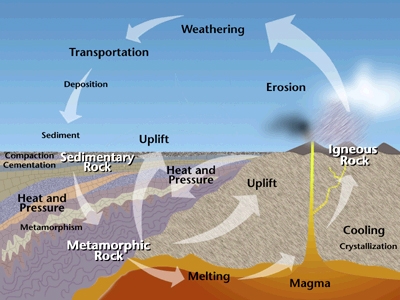
    rock cycle

    The Rock Cycle via video for Igneous Rock, Sedimentary Rock and Metamorphic Rock

    These are the concepts that my kids find confusing, so I’ve added some extra information from sites to help kids understand the differences. This great information is from Mr.SciGuy.

    Erosion versus Weathering

    This is from Compare Anything.

    Weathering and erosion are geological processes that act together to shape the surface of the Earth.

    Erosion is displacement of solids (soil, mud, rock and other particles) usually by the agents of currents such as, wind, water, or ice by downward or down-slope movement in response to gravity or by living organisms.

    Weathering is the decomposition of rocks, soils and their minerals through direct contact with the Earth’s atmosphere.

    This video shows weathering verus erosion through some great demonstrations. It’s 9 minutes long.

    This is a confusing concept, so here’s more:

    What’s the difference between weathering and erosion?

     Weathering involves two processes that often work in concert to decompose rocks. Both processes occur in place. No movement is involved in weathering. Chemical weathering involves a chemical change in at least some of the minerals within a rock. Mechanical weathering involves physically breaking rocks into fragments without changing the chemical make-up of the minerals within it. It’s important to keep in mind that weathering is a surface or near-surface process. As you know, metamorphism also produces chemical changes in rocks, but metamorphic chemical changes occur at depth where either the temperature and/or pressure are significantly higher than conditions found on the Earth’s surface.
     As soon as a rock particle (loosened by one of the two weathering processes) moves, we call it erosion or mass wasting. Mass wasting is simply movement down slope due to gravity. Rock falls, slumps, and debris flows are all examples of mass wasting. We call it erosion if the rock particle is moved by some flowing agent such as air, water or ice.
     So, here it is: if a particle is loosened, chemically or mechanically, but stays put, call it weathering. Once the particle starts moving, call it erosion.

    This is from The National Park Service.

    Here’s a fun video from Scholastic:

    —————–

    Rock versus Minerals

    The Museum of Science does a great school classroom presentation called Rock Detectives. One great example they gave of rocks versus minerals is this:

    Chocolate Chip Cookie

    rocks versus minerals chocolate chip cookie example

    What ingredients are used to make a chocolate chip cookie? Kids will answer with things like: flour, butter, sugar and chocolate chips.

    The chocolate chip cookie is LIKE A ROCK made up of ingredients. Ingredients are LIKE MINERALS.

    What happens if instead of baking, you fry it instead? You get … chocolate chip pancakes. So, depending on what happens to the mix of minerals (for example, different pressures and/or heat), there are different outcomes. JUST LIKE minerals and rocks.

    Rocks

    A rock is a mixture of one or more minerals. They are classified by the way that they are made.

    A mineral is

    • Naturally occurring
    • Inorganic
    • Definite chemical composition & crystalline structure
    • Solid

    Mineral Identification Tests

    The Color Test- easiest test to do but not always reliable

    The Streak Test

    • The color of the powdered mineral.
    • Performed by rubbing the unknown mineral on an unglazed tile.

    The Luster Test

    • the way a mineral shines or doesn’t shine
    • the only way to really learn the different lusters is to see them for yourself.

    Types of Luster

    • Metallic– looks like shiney metal
    • Non-metallic– all the other ways that a mineral can shine
      • Glassy/vitreous– shines like a piece of broken glass (most common non-metallic)
      • Dull/earthy– no shine at all
      • Resinous/waxy- looks like a piece of plastic or dried glue
      • Pearly– looks oily it may have a slight rainbow like an oil slick on water. Also looks like the inside of some clam shells
      • Adamantine– brilliant, sparkling shine like a diamond

    Hardness– a minerals resistance to scratching. This should not be confused with brittleness. A diamond is very hard and will scratch a hammer but a hammer will smash a diamond. Likewise, talc, one of the softest minerals, is not squishy. It will still put a serious hurting on you if you get hit in the head with it.

    This awesome chart is for sale here. Includes all 6 crystal classes and presents the physical properties: hardness, habit, luster, cleavage, specific gravity, color, fluorescence, and streak.

    ——————–

    Types of Rocks

    Igneous Rocks

    “Fire Formed”– melted rock material cools and solidifies (“freezing”)

    • Intrusive– rock formed inside the Earth
    • Extrusive– rock formed on the surface
    • Texture– the size of the crystals- NOT HOW IT FEELS

    Sedimentary Rocks

    Made from sediments or rock material that has been broken down in some way.

    • Sedimentary rocks are usually formed in a watery environment.
    • Often layered
    • Are the only rocks that normally contain fossils

    Metamorphic Rocks

    • changed from a pre-existing rock
    • caused by extreme heat and/or pressure

    —————–

    Cleavage versus Fracture

    Cleavage -To break along flat surfaces.

    Examples of Cleavage (these examples are not on the test but I think they are helpful to illustrate cleavage visually).

    • Cubic– To break into cubes

    • Rhombihedral– to break into “pushed over cubes”

    • Basal– to split into thin sheets

    Fracture -The way a mineral without cleavage breaks.

    Examples of Fracture (This is not on the test, but it might help your child get a visual sense of a fracture — think bowl shape, needs, or sharp edges).

    • conchoidal– to break in a scooped out bowl shape- like a conch (sea snail)
    • hackly fracture– to have irregular sharp edges
    • splintery– to break into long, thin needles

    —————-

    This is not on the test, but here are more details on rocks versus minerals to help your child solidify this concept. This is from Rocks For Kids.

    ROCKS

    All rocks are made of 2 or more minerals, but minerals are not made of rocks.

    Rock Words: There are many common names for rocks and the usually give you an idea of how big the rock is. Here are a few:

    • mountain – huge, giant hunk of rock that is still attached to the earth’s crust, doesn’t move, tall
    • boulder – large, taller than a person
    • rock – large, you could get your arms around it or a bit smaller but it is usually jagged,
      broken off a bigger piece of rock
    • river rock – round rocks that are along the edge & at the bottom of fast-flowing rivers
    • stone – medium, you could hold it in two hands
    • pebble – small, you can hold it with two fingers, could get stuck in your shoe, usually rounded
    • sand – made up of tiny pieces of rock, grains of sand
    • grain – tiny, like a grain of rice or smaller, often found on a beach
    • dust – really fine powder that is mixed in with sand or soil
    • speck – as in a speck of dirt


    MINERALS

    • A mineral is the same all the way through. That is one reason we speak of
      a sample or a specimen rather than a rock.
    • There are about 3000 known minerals on earth.
    • All rocks are made up of 2 or more of these minerals.


    Finally, here is a video of rocks versus minerals by kids.

  • Phases of Moon Study Guide for 4th Grade Science

    Phases of Moon Study Guide for 4th Grade Science

    Moon phases diagram, 4th grade science, Newtonimage from Moon Connection

    My kids study phases of the moon in 4th grade and both girls seemed to have problems with getting Waxing versus Waning straight in their heads despite a week of study. It could be that Waxing Crescent Moons look pretty similar to Waning Crescent Moons. I think Oreos would help with this!

    I have a fun moon project that a Dad Friend first did for my oldest when she was in preschool. Clearly, it didn’t sink in but perhaps repetition is key. I’d use the mini-oreos myself for creating a cookie based phases of the moon chart. If you want to try it, it’s below.

    Some kids might need a more detailed explanation and I found this from Moon Connection.

    Other kids might like a video.


    Diagram Explanation

    The illustration may look a little complex at first, but it’s easy to explain.

    Sunlight is shown coming in from the right. The earth, of course, is at the center of the diagram. The moon is shown at 8 key stages during its revolution around the earth. The moon phase name is shown alongside the image. The dotted line from the earth to the moon represents your line of sight when looking at the moon. To help you visualize how the moon would appear at that point in the cycle, you can look at the larger moon image. This means for the waning gibbous, third quarter, and waning crescent phases you have to mentally turn yourself upside down. When you do this, you’ll “see” that the illuminated portion is on your left, just as you see in the large image.

    One important thing to notice is that exactly one half of the moon is always illuminated by the sun. Of course that is perfectly logical, but you need to visualize it in order to understand the phases. At certain times we see both the sunlit portion and the shadowed portion — and that creates the various moon phase shapes we are all familiar with. Also note that the shadowed part of the moon is invisible to the naked eye; in the diagram above, it is only shown for clarification purposes.

    So the basic explanation is that the lunar phases are created by changing angles (relative positions) of the earth, the moon and the sun, as the moon orbits the earth.

    If you’d like to examine the phases of the moon more closely, via computer software, you may be interested in this moon phases calendar software.


    Moon Phases Simplified

    It’s probably easiest to understand the moon cycle in this order: new moon and full moon, first quarter and third quarter, and the phases in between.

    As shown in the above diagram, the new moon occurs when the moon is positioned between the earth and sun. The three objects are in approximate alignment (why “approximate” is explained below). The entire illuminated portion of the moon is on the back side of the moon, the half that we cannot see.

    At a full moon, the earth, moon, and sun are in approximate alignment, just as the new moon, but the moon is on the opposite side of the earth, so the entire sunlit part of the moon is facing us. The shadowed portion is entirely hidden from view.

    The first quarter and third quarter moons (both often called a “half moon“), happen when the moon is at a 90 degree angle with respect to the earth and sun. So we are seeing exactly half of the moon illuminated and half in shadow.

    Once you understand those four key moon phases, the phases between should be fairly easy to visualize, as the illuminated portion gradually transitions between them.

    An easy way to remember and understand those “between” lunar phase names is by breaking out and defining 4 words: crescent, gibbous, waxing, and waning. The word crescent refers to the phases where the moon is less that half illuminated. The word gibbous refers to phases where the moon is more than half illuminated. Waxing essentially means “growing” or expanding in illumination, and waning means “shrinking” or decreasing in illumination.

    Thus you can simply combine the two words to create the phase name, as follows:

    After the new moon, the sunlit portion is increasing, but less than half, so it is waxing crescent. After the first quarter, the sunlit portion is still increasing, but now it is more than half, so it is waxing gibbous. After the full moon (maximum illumination), the light continually decreases. So the waning gibbous phase occurs next. Following the third quarter is the waning crescent, which wanes until the light is completely gone — a new moon.


    The Moon’s Orbit

    You may have personally observed that the moon goes through a complete moon phases cycle in about one month. That’s true, but it’s not exactly one month. The synodic period or lunation is exactly 29.5305882 days. It’s the time required for the moon to move to the same position (same phase) as seen by an observer on earth. If you were to view the moon cycling the earth from outside our solar system (the viewpoint of the stars), the time required is 27.3217 days, roughly two days less. This figure is called the sidereal period or orbital period. Why is the synodic period different from the sidereal period? The short answer is because on earth, we are viewing the moon from a moving platform: during the moon cycle, the earth has moved approximately one month along its year-long orbit around the sun, altering our angle of view with respect to the moon, and thus altering the phase. The earth’s orbital direction is such that it lengthens the period for earthbound observers.

    Although the synodic and sidereal periods are exact numbers, the moon phase can’t be precisely calculated by simple division of days because the moon’s motion (orbital speed and position) is affected and perturbed by various forces of different strengths. Hence, complex equations are used to determine the exact position and phase of the moon at any given point in time.

    Also, looking at the diagram (and imagining it to scale), you may have wondered why, at a new moon, the moon doesn’t block the sun, and at a full moon, why the earth doesn’t block sunlight from reaching the moon. The reason is because the moon’s orbit about the earth is about 5 degrees off from the earth-sun orbital plane.

    However, at special times during the year, the earth, moon, and sun do in fact “line up”. When the moon blocks the sun or a part of it, it’s called a solar eclipse, and it can only happen during the new moon phase. When the earth casts a shadow on the moon, it’s called a lunar eclipse, and can only happen during the full moon phase. Roughly 4 to 7 eclipses happen in any given year, but most of them minor or “partial” eclipses. Major lunar or solar eclipses are relatively uncommon.


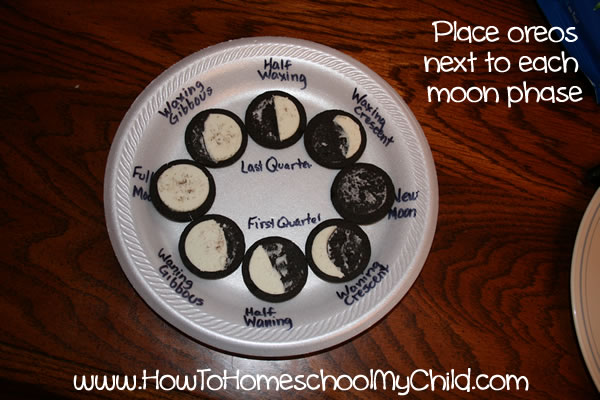
    Oreo Phases of Moon Fun Project from How to HomeSchool My Child

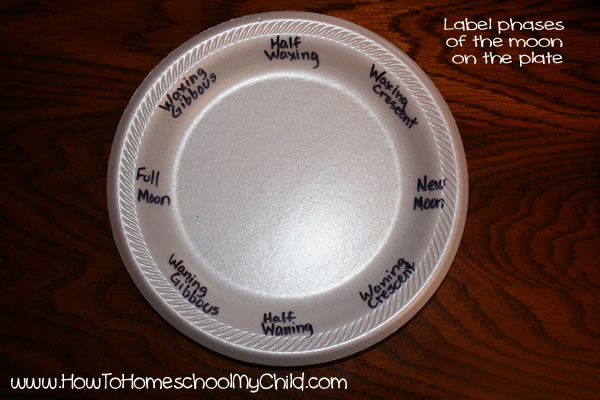
    Oreo Phases of the Moon – Homeschool Activity

    Obviously, you’ll need a package of Oreos.  Each child will need 8 Oreos, a butter knife and a paper plate.  You may need more than 8 Oreos if they crack on you. You can use the mini Oreos too.

    Oreo Phases of the Moon 1

    Depending on the age of your child, let them use a Sharpie to label each phase on the paper plate.

    Oreo Moon Phases1

    Be very careful as you separate your Oreos.
    I had a few crack, so I had to eat them.  Gosh!
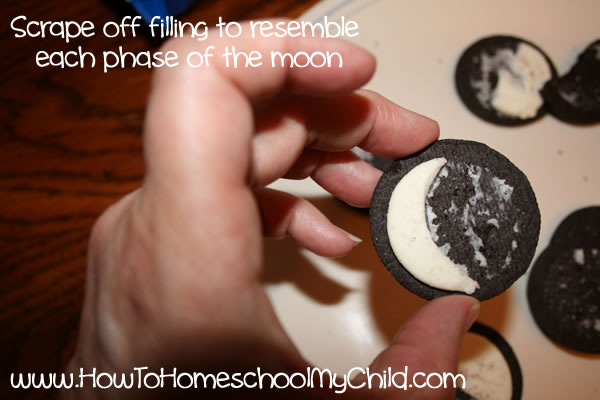
    The full moon & new moon are already done when you pull apart your Oreo.

    Oreo Moon Phases 2

    It may take practice, but each child needs to scrape off the filling to create 2 crescent moons, 2 half moons and 2 ginnous moons.

    Oreo Phases of the Moon 2


  • The Village Bank will award $40,000 in college scholarships to Newton, Wayland students

    The Village Bank will award $40,000 in college scholarships to Newton, Wayland students

    The Village Bank, College Scholarships, Newton, Wayland, ILoveNewton.comKenneth C. Brennan, president and CEO of The Village Bank, announced today that the Bank’s Auburndale Community Charitable Foundation will award a total of $40,000 in college scholarships to Newton and Wayland residents who are graduating from high school this year and intending to pursue studies at an accredited college or university in the fall.

    The Foundation will award 10 one-time $2,000 scholarships and two $10,000 scholarships that will be allocated upon successful completion of the first semester of each of the student’s four academic years.

    To be eligible for one of the two $10,000 scholarships, a student must have demonstrated active involvement in local community and/or charitable causes.

    “The Village Bank has always had a strong commitment to the community,” said Brennan. “The special $10,000 scholarships give us the opportunity to recognize local students who share that commitment.”

    While the $2,000 scholarships also take into account an applicant’s community/charitable experience, it is not a requirement for consideration. The scholarships will be presented upon successful completion of the students’ first semester.

    Each of the scholarship awards can be applied toward college tuition, room and board or supplies. Requirement information and application forms are available at local high schools and at The Village Bank branches in Auburndale, Newtonville, Nonantum, Newton Highlands, Waban, West Newton and Wayland, and online by clicking here. Completed applications must be received by the Bank no later than April 13, 2012.

    Auburndale Community Charitable Foundation scholarships are funded in part by the Bank’s Annual Golf Classic each fall. The scholarship program began in 1998 with the announcement of five $2,000 scholarships to be awarded to members of that year’s graduating class.

    The Foundation’s total investment in education since the program began will total $390,000 with this year’s awards, according to Brennan.

  • 5th Grade Science Unit on Weather: Air Pressure, Heat, Moisture and Wind.

    5th Grade Science Unit on Weather: Air Pressure, Heat, Moisture and Wind.

    weather air pressure heat moisture wind dew point humidity PragmaticMom Pragmatic Mom
    I just saw the Museum of Science of Boston’s presentation on weather for 5th graders today and I remembered how difficult it was for me to help my fifth grader figure out how to study for her weather unit. I spent hours googling weather terminology to help her with flashcards but then, trying to put together all the casual relationships was confusing, even to me.

    While that weather presentation was fresh in my head, I thought I’d capture it and have also added links and video to help kids really understand these concepts.

    p.s. I was pre-med in college so I never actually studied the weather. Please leave a comment to add to this or to make corrections. Especially you, George, from the Museum of Science. Thank you! Also leave questions if anything is confusing and I’ll keep adding to this.

    p.p.s. I am adding a great post by Doodles and Jots about Clouds. She has cloud photos, cloud types diagram, & companion art project.

    What Causes Weather: Heat, Air Pressure, Wind and Moisture

    Heat: is from our sun. The light energy from the sun converts to heat energy when it hits the earth.

    The tilt of the planet affects how much heat an area on the planet receives and this is also why we have seasons. Because the earth is sphere, when it is tilted the light energy in the middle of the planet is spread out a smaller distance than the top or the bottom (depending on angle of the tilt). The same light energy which converts to heat energy upon hitting the earth means less heat for a larger area versus a smaller area. [see link for explantory video]

    Air pressure: is the weight of the Earth’s atmosphere pressing down on everything at the surface. Explaining Air pressure video from The Weather Channel. Watch to learn how air pressure is caused by heat (more heat is less pressure because molecules spread out so air rises, and less heat makes molecules squish together so pressure falls.)

    The relationship between air pressure and heat. Cold air is more dense (has a greater weight per unit volume) than warm air. If the air is unconfined and heated — as would be the circumstances in the atmosphere — the density of the gas decreases (i.e. gets lighter). This is because the molecules in the air spread out when heated, causing air pressure to decrease. Think of a hot air balloon. Heating the air causes the air balloon rise because the heated air is lighter than the colder air around it.

    The relationship between air pressure and weather. Air has weight, and a barometer measures the changes in air pressure above. When a high-pressure area is in control, the air sinks. Sinking air inhibits the development of clouds. When the air sinks, more force pushes down toward the ground, so the barometric pressure increases. Conversely, when a low-pressure area moves in, the air rises, cools and condenses out moisture, which forms clouds and precipitation. Since a rising column of air above weighs less, the air pressure falls.

    As the sun heats the ground or ocean, warning them, the air near the ground or ocean warms and becomes less dense. As this happens the air begins rising, which lowers the air pressure at the Earth’s surface.

    Very cold air, on the other hand, can create large areas of high pressure because cold air is more dense (heavier) than warm air. The Earth’s highest surface air pressures are found in masses of very cold air over places such as Siberia.

    The relationship between air pressure and wind. Air pressure and wind speed are related: as air pressure drops, wind speed increases.

    Wind: is air in motion. It is produced by the uneven heating of the earth’s surface by the sun. See video below to learn how changes in air pressure from high to low pressure cause wind.

    Moisture: water can exist in three different states: solid, liquid, and vapor.

    Water droplets form from warm air. As the warm air rises in the sky it cools. Water vapor (invisible water in the air) always exists in our air. Warm air holds quite a bit of water. For example, in the summer it is usually very humid. When enough of these droplets collect together, we see them as clouds. If the clouds are big enough and have enough water droplets, the droplets bang together and form even bigger drops. When the drops get heavy, they fall because of gravity, and you see and feel rain.

    A cloud is a large collection of very tiny droplets of water or ice crystals. The droplets are so small and light that they can float in the air.

    How are Clouds Formed? All air contains water, but near the ground it is usually in the form of an invisible gas called water vapor. When warm air rises, it expands and cools. Cool air can’t hold as much water vapor as warm air, so some of the vapor condenses onto tiny pieces of dust that are floating in the air and forms a tiny droplet around each dust particle. When billions of these droplets come together they become a visible cloud.

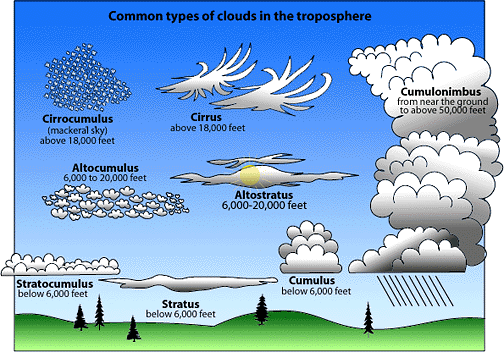
    Cloud Types

    Latin Root                   Translation                 Example

    cumulus                           heap                                   fair weather cumulus
    stratus                              layer                                  altostratus
    cirrus                                curl of hair                      cirrus
    nimbus                             rain                                    cumulonimbus

    cloud chart, weather, 5th grade science of weather

    Humidity: is the amount of moisture in the air. The relative humidity is the amount of moisture in the air as a percentage of the most moisture that could be in the air at a certain temperature. If the air has half the amount of moisture it could have then the relative humidity is 50%.

    Dewpoint: Another popular expression of humidity is the dewpoint. This is the temperature that the relative humidity will be 100% when air is cooled. When air cools the relative humidity will increase. It will continue to increase as the air cools until it reaching the saturation point. Morning dew is common in humid places in the morning. This occurs from air cooling to the dewpoint and further cooling results in condensation.

    Climate versus Weather

    Mountains and Climate: The temperature on mountains becomes colder the higher the altitude gets. Mountains tend to have much wetter climates than the surrounding flat land.

    Oceans and Climate: the ocean responds very slowly to changes in the seasons, causing it to have a moderating effect on climate (i.e. water is harder to heat or cool than land so it affects the weather around it). The sea makes winters in coastal regions a bit warmer and summers near the coast a bit cooler than they are farther inland. . Notice how coastal cities have milder winters and more pleasant summers.

    On a smaller scale, the sun heats up land faster than nearby water, causing the air over land to begin rising sooner than air over the ocean. As rising air over the land creates lower air pressure, cooler air from over the ocean flows in to replace it, creating a sea breeze.

    Climate versus Weather: The difference between weather and climate is a measure of time. Weather is what conditions of the atmosphere are over a short period of time, and climate is how the atmosphere “behaves” over relatively long periods of time.

    More Terms

    Barometer: A barometer measures atmospheric pressure.

    Barometric Pressure: another term for air pressure or atmospheric pressure. Air pressure is also called barometric pressure because barometers are used to measure it.

    Atmospheric Pressure: or air pressure is the force exerted on you by the weight of tiny particles of air (air molecules).

    Molecule: Molecules are small particles that make up all living and non-living things. They are made up of even tinier particles called atoms.

    Temperature: Temperature is a degree of hotness or coldness the can be measured using a thermometer. It’s also a measure of how fast the atoms and molecules of a substance are moving. Temperature is measured in degrees on the Fahrenheit, Celsius, and Kelvin scales.


  • Best Preschools in Newton UPDATED

    Best Preschools in Newton UPDATED

    best preschool nursery school montesorri school day care in Newton MAPreschools, Day Care, Toddler Care in Newton

    This list is from Newton’s Wikipedia page. I noticed that it’s not a comprehensive list, so please add in any preschools that you know as a comment and I’ll add the link to the page. We think this is a comprehensive list of all the preschools (Montesorri, Cooperative, Day Care, Home Preschools, etc. ) that we know of. We don’t know what the “best” preschools are; that’s very subjective but I think it starts by looking at a lot of preschools and taking time to really spend time in the classroom. Look for clues like how clean the bathrooms are and how the rooms are decorated. Ask if there are parents from your neighborhood and then track them down for their honest opinion.

    Leave a comment to ask a question.  Also, please leave comments about your preschool experience. Thanks!

    Here are other links on preschools:

    How To: Pick a Preschool

    Top 10 Starting Kindergarten or Preschool Picture Books

    Why Preschool Helps You Get a Job

    Preparing for Kindergarten: Activities to do With Your Child


    Newton Preschools: A Comprehensive List

    • Rosenshine Nursery School, Temple Reyim, 1860 Washington Street, Waban
    • Capability:Mom posted her experience here.
    • Presbyterian Church Nursery School 75 Vernon Street
    • Temple Beth Avodah Nursery School, 45 Puddingstone Lane
    • Beth-El Pre-School, 561 Ward St.
    • Burr Cooperative Nursery School, 64 Hancock St., Auburndale
    • The Teddy Bear Club Preschool, 1466 Commonwealth Ave, West Newton. French bilingual program, meaning half of the instruction (including all literacy) is taught in English. Accepting toddlers starting at 22 months
    • Bernice B. Godine JCC Early Learning Center, Leventhal-Sidman JCC, 333 Nahanton St.
    • The Children’s Cooperative Nursery School, 848 Beacon St.
    • Temple Shalom Nursery School, 175 Temple St. (Many of my non-Jewish Mom friends send their kids here. Great proximity to Peirce Elementary School and just a great place for kids).
    • Walnut Park Montessori School, 47 Walnut Park (All my Mom Friends who went here were happy)
    • Auburndale Community Nursery School, 230 Central St.
    • Rockwell Nursery School at Lasell College, 70 Studio Road (Full day preschool used to teach Lasell students about Early Childhood Education.)
    • The Barn at Lasell College, 1844 Commonwealth Ave, Auburndale (daycare)
    • Newton Community Service Center, 492 Waltham Street
    • Parkside Preschool, 474 Centre Street, Newton Corner (I have one Mom Friend whose two kids went here. She was very happy with it).
    • The Preschool Experience, 1091 Centre Street (I’ve always heard great things about this preschool but don’t actually know anyone who went there)
    • Upper Falls Nursery School, 45 Pettee St, Newton Upper Falls
    • Bilingual Beginnings at Pine Village Preschool 1326 Washington Street, West Newton (Spanish Immersion)
    • West Newton Children’s Center Washington St, West Newton (gives a lot of flexibility in term of what hours you want)
    • Little Red Wagon Playschool 50 Winchester Street, Newton Highlands
    • Second Church Nursery School, 60 Highland Street, West Newton Hills
    • Bowen Cooperative Nursery School, 96 Otis Street, Newtonville (Two of my kids went here. The teachers are fantastic but the coop format is not for everyone. Also, very short days.)
    • Brookline Infant Toddler Center (BITC), 1900 Commonwealth Ave, Auburndale (My two oldest went here. It’s great if you need infant child care and full day coverage.) My neighbor Kathleen says, “Our sons went to Brookline Infant Toddler Center (BITC) at the corner of Auburn street and Commonwealth ave. It has been a number of years but we loved it. “
    • Plowshares, 457 Walnut Street, Newtonville. At Newton North High School, Franklin Elementary School, and Lincoln-Elliot Elementary School.
    • Newton School for Children, 25 Lenglen Rd # 2
    • Golden Days Children’s Center, 66 Needham Street
    • Happy Child Day Care and Preschool, 1191 Chestnut Street
    • JAMS Preschool, 1671 Beacon Street, Waban (will take very young preschoolers and everyone I know who went there loves it)
    • Longfellow Preschool, 777 Dedham Street, at Mount Ida College
    • Suzuki Preschool, 1860 Washington St, Newton
    • Camp Echo Bridge Preschool, 124 Vernon Street, Newton
    • Hills and Falls Cooperative, 258 Concord Street, Newton Lower Falls (My summer camp director teaches here and she’s wonderful)
    • Echo Falls Preschool, 545 Grove Street, Newton Lower Falls
    • Newton Child Care, 225 Nevada, West Newton
    • Barbara’s Day Care, 404 Homer Street
    • Meeting House Child Care, 848 Beacon Street
    • Newton Montessori, 80 Crescent Avenue (I’ve also heard good things about this school)
    • Children’s Corner at Newton Wellesley Hospital, 2014 Washington St, Waban (A Mom Friend was very happy here. They have 12 hour coverage also because they provide child care for medical staff but you don’t need to work there to go here)
    • Newton Creative Start, 573-B Washington Street, Watertown
    • Newton School for Children, 25 Lenglen Road, Newton Corner
    • Victorian Montesorri, 3 Curtis St , Newton Highlands
    • Newton Early Childhood Program,  100 Walnut Street, Newtonville
    • Panda Cub Academy (Mandarin Chinese immersion preschool), 1200 Boylston Street, Brookline/Chestnut Hill
    • Weekday Nursery School, 54 Lincoln Street, Newton Highlands
    • Jewish Creative Preschool, 349 Dedham Street, Newton, MA 02459
    • Saplings Preschool, 0 Carlton Rd, Waban, MA 02468

    Preschools Specifically for Toddlers in Newton

    These two three schools are for 2 year olds who are typically too young for most preschools where you must be 2.6 years old in September.

    Toddler Loving Care

    66 Walnut Street

    West Newton

    My neighbor says, “When your little one gets a little older keep “Toddler Loving Care” on your list.  It is a fantastic preschool.  It is the multicolored Victorian building near the Ed Center on Walnut Street.  Our youngest Sammy went there.” (Ann)

    Jams in Waban

    1671 Beacon St
    Newton, Ma 02168

    My mom friends were very happy at Jams. They typically used JAMS for a pre-preschool before moving them to the preschool where their older siblings were.

    Green Peas Toddler Care in Newton Centre

    My mom friend Katherine raved about Green Peas. It’s a half day 1, 2 or 3 mornings a week. She described it as “very sweet” and especially liked the tiny yogurt and other healthy items for snack. Her kids did a year here before preschool and she highly recommended it to me.

    Saplings Preschool in Waban

    We are a nurturing play and theme based program geared towards the 2 year old and offer an enriching curriculum in a beautiful indoor/outdoor space in Waban.

    p.s. Other Guides to Newton:

    A Fairly Comprehensive List of Birthday Party Locations and Ideas for Kids in Newton and Boston

    Best Martial Arts Schools for Kids and Adult in Newton

    A Fairly Comprehensive List of After School Supplemental Math Classes in Newton

    A Fairly Comprehensive List of Dance Studios in Newton

    Best Gymnastics for Toddlers and Kids in Newton Area

    Best Caretaker and Child Music Classes in Newton

    Best Tutors, Music Teachers etc in Newton


  • $5k College Scholarships from Hood for New England Athletes (Girls and Boys) Who Volunteer

    $5k College Scholarships from Hood for New England Athletes (Girls and Boys) Who Volunteer

    Hood Milk Scholarships athletes ILoveNewton MA High School college The Hood Sportsmanship Scholarship presented by Hood Milk is open to seniors enrolled in a high school in one of the six New England states. Seniors must be attending a two- or four-year accredited college or university in the fall of 2012 and meet the following criteria:

    * Minimum of a 3.0 GPA
    * Participated in a varsity sport in high school
    * Volunteered in his/her community
    * Displayed a high degree of sportsmanship while participating in sports in high school

    “The Hood Sportsmanship Scholarship program was established to recognize exceptional high school seniors in New England,” said Lynne Bohan, spokesperson for Hood. “We have been overwhelmed by the quality of submissions from students over the past two years, and look forward to celebrating 18 more students who serve as role models in their classes, communities and on their respective sports teams.”

    Students can enter for a chance to win the Hood Sportsmanship Scholarship online at Hood.com now through February 1st, 2012. Students will be asked to complete the application form and write a short essay explaining how they display sportsmanship and integrity on and off the field. Voting will be open to the public beginning on February 15th and will run through March 15th online at Hood.com to determine the 10 finalists from each state who will be interviewed by a panel of judges. The final 18 winners — 3 from each state — will be notified in May and be invited to attend an awards banquet.

    Three high school seniors in each of the six New England states — Connecticut, Maine, Massachusetts, New Hampshire,Rhode Island and Vermont — will be awarded a $5,000 college scholarship for a total of $90,000.

    For more information, and rules and regulations, please visit Hood.com.


  • Newton North High School: A Walk Down Mural Lane

    Newton North High School: A Walk Down Mural Lane

    Getting nostalgic and want to have a keepsake of these memories? You are in luck! Click here to purchase.

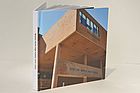
    Newton North High School Coffee Table year book Sharon Schindler I Love Newton MA This gorgeous coffee table book that depicts the old Newton North High School is $85 and was lovingly photographed by Newton photographer, Sharon Schindler.

    She also has more images available. Here’s a sampling:

    Old Newton North High School Posters

    Old Newton North High School 9 Piece Canvas

    Old Newton North High School Demolition

    Old Newton North High School Mosaic Tiles


  • New Funnel Playground Toy at Peirce Elementary: Temple and Dartmouth Street

    New Funnel Playground Toy at Peirce Elementary: Temple and Dartmouth Street

    Funnel Ball playground equipment game like basketball Newton ILoveNewton Peirce Elementary SchoolThis new Funnel Ball makes shooting baskets much easier. You just aim for the big funnel at the top. This was the Class Gift from Peirce’s Class of 2011 5th Graders and was recently installed.

    The next time you drive by the 4-square courts along Temple Street take a look … it’s the tall blue pole with a red bucket sitting on top. Balls are tossed into the large hole on top and then they exit through 1 of 3 different holes. It should offer added fun to the playground for many years to come. Bring your 4 square ball!
    Peirce Elementary School is located at 170 Temple Street in West Newton.
    Thank you again to Peirce’s Graduating Class of 2011!
  • The Transformation of Newton North High School: A Photograph Exhibit by Sharon Schindler

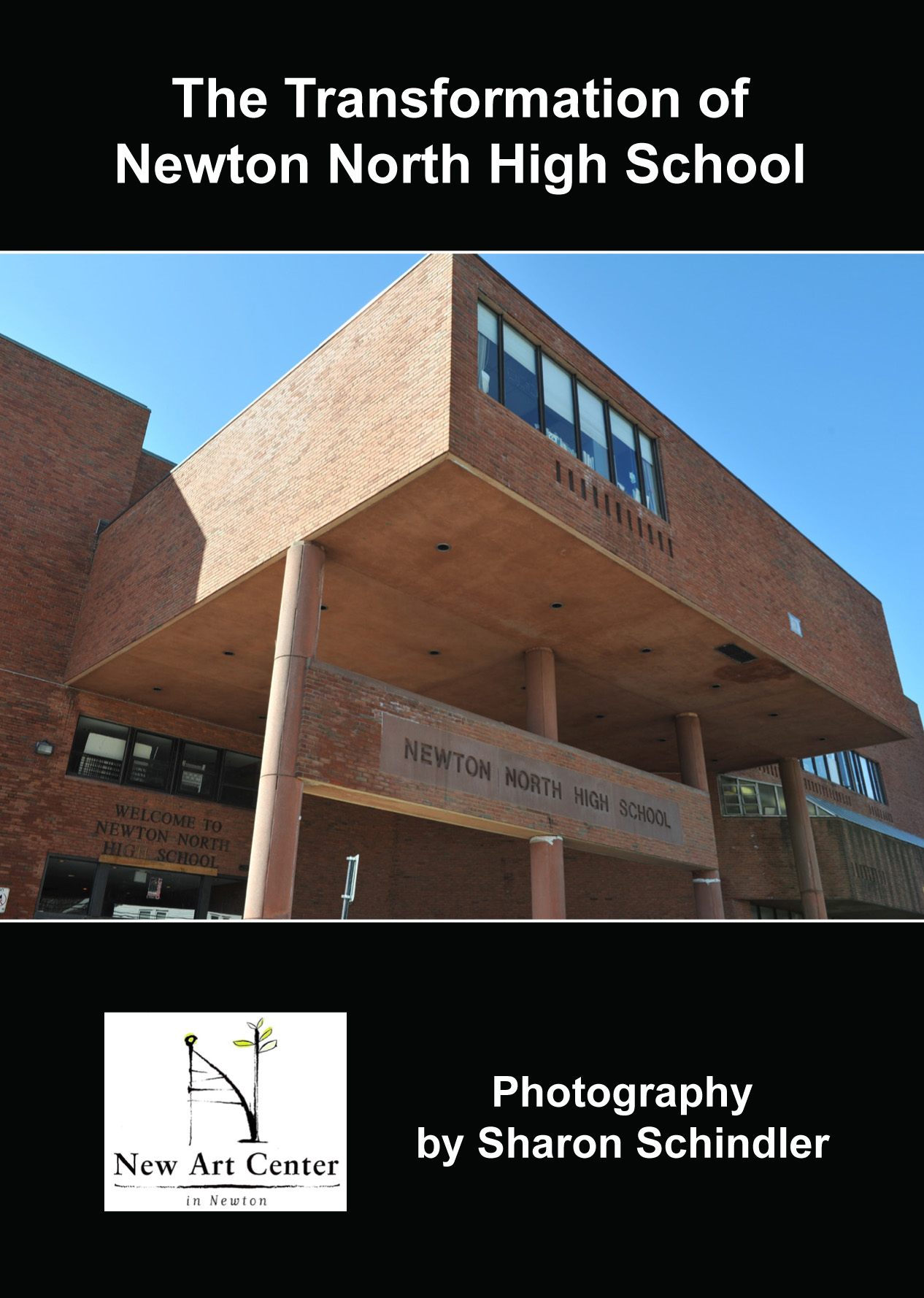
    The Transformation of Newton North High School: A Photograph Exhibit by Sharon Schindler

    Newton North High School New and Old Sharon Schindler Photographer I Love Newton MA

    It’s gone, but you can still see it here!

    Please join us for the Opening Reception of a photograph exhibit on the old but beloved Newton North High School. Photography is by local acclaimed photographer Sharon Schindler.

    Opening Reception: Wednesday, December 7th from 6:00-8:30 pm

    Location: New Art Center, Main Gallery, 61 Washington Park

    Exhibit Timeframe: December 7 -14, 2011. Holzwasser Gallery Hours: M-F 9-5, Sat 1-5


  • School Committee Recommendations from Current School Committee Member Kurt Kusiak

    School Committee Recommendations from Current School Committee Member Kurt Kusiak

    Newton Political Races Alderman School Committee Kurt KusiakKurt Kusiak is my Dad Friend and neighbor and, because I have zero interest in politics of any ilk, I turn to him like my personal Godfather to vote his slate. Perhaps I am just lazy and bad with names such that I can’t keep track of so many people and their agendas. On the other hand, I find that my beliefs align with Kurt’s.

    My pediatric dentist’s wife, Vicki Danberg, is running for Alderman At-Large in Ward 6. I am also voting for her (assuming that I vote in Ward 6).

    ——————–

    Friends,

    Next Tuesday, November 8, is an important election day for choosing the next School Committee.  I hope you will take the time to vote since there are very substantial differences between some of the candidates this time around.  Voting for School Committee candidates is city wide, so you can vote in every race, regardless of whether it is your ward.

    For those of you who may be interested, my recommendations for the three races are:

    Jonathan Yeo:  Jonathan’s contributions to the School Committee are not replaceable.  He has led the negotiations with the teachers union, which has just resulted in the first sustainable teachers contract for a long, long time – saving many millions of dollars and, simultaneously, many teachers’ jobs.  He is an exceedingly skilled and experienced member of the committee that we cannot afford to lose.

    Sue Rosenbaum: Sue is a scientist that has done diabetes and obesity research at Tufts Medical School and currently works as a clinical trials manager for a start-up pharmaceutical company.  She has also been a long-time activist and volunteer improving Newton’s schools, serving on the League of Women Voters, the Zervas and Newton South school councils, as a soccer coach, and as a creative arts and sciences volunteer.  During her first term on the Newton School Committee, she has served as the liaison to our legislative delegation at the State House and as a member of the budget guidelines committee, and on the facilities committee bringing needed modulars to the elementary schools.  She has also served on the Countryside Elementary School Task Force, which is working to alleviate school overcrowding.  She gets things done and achieves positive results without much fanfare, which I like a lot.

    Diana Fisher-Gomberg: Diana has been very active in the Newton schools for the past eight years.  She has been a very hard worker for several PTOs and School Councils, and she is well-respected and well-liked by many city officials – which is fairly key to getting things done.  Her commitment to the school system is clear, she has a good knowledge base already due to her years of interacting with the School Committee and administration, and I think she would make a very good School Committee member.

    Kurt Kusiak