If you are new to Newton and want to know about the Newton tax override, I have a round up of links. This is only the second tax override to pass in Newton. The first was to renovate and build Newton’s High Schools. What does the override mean to Newton’s citizens and what next?
How Close Was It?
From Newton Patch: Newton Voters Pass $11.4M Override Package
The unofficial vote totals for the three questions:
Question 1
The first override question proposed would allow for an $8.4 million tax levy limit override to fund a list of projects, most of which will help with overcrowding and enrollment in the Newton Public Schools.
Yes: 9,649
No: 8,199
Question 2
Replace or renovate Angier Elementary School?
Yes: 9,904
No: 7,893
Question 3
Replace or renovate Cabot Elementary School?
Yes: 9,879
No: 7,919
What if You Can’t Afford Tax Increase?
From Village 14: Statement from Mayor Warren’s office on Newton overrides
When he announced the override package last fall, Mayor Warren also announced an expansion of tax assistance programs for eligible seniors and veterans. A staff person at City Hall has also been designated to help residents concerned about their ability to pay. If you are in need of assistance, you may call Meghan Kennedy at 617-796-1282
image from Village 14
50 New Teaching Positions Added to Newton Schools
From Newton Patch: Newton Superintendent: FY ’14 Budget Will Add More than 50 Teaching Positions
Of the more than 50 new positions slated in next year’s budget, 13.1 FTE (full-time equivalent) positions will be added on the elementary school level, 10.1 of which are for enrollment growth.
Three of those elementary school positions will be new, part-time assistant principals at the district’s three largest elementary schools: Countryside, Bowen and Memorial-Spaulding.
The elementary assistant principal positions are a new venture for the Newton Public Schools, but according to Fleishman, they are a common practice in Newton’s “peer districts.” Fleishman added that the part-time assistant principals will be full-time staffers who split their time between the assistant principal job and a teaching position.
Other additions include:
More than 11 new positions at the middle schools
More than 11 new positions at the high schools
3.5 FTE for English Language Learners
One new HR position to handle increase in hires as well as new, expanded background checks for teachers
The 50 added positions in fiscal 2014 represent an approximate 3 percent increase to the district’s overall staff, which will total 1,924.6 positions in fiscal 2014.
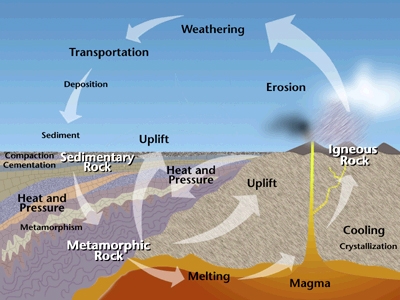
The Rock Cycle via video for Igneous Rock, Sedimentary Rock and Metamorphic Rock
These are the concepts that my kids find confusing, so I’ve added some extra information from sites to help kids understand the differences. This great information is from Mr.SciGuy.
Erosion versus Weathering
This is from Compare Anything.
Weathering and erosion are geological processes that act together to shape the surface of the Earth.
Erosion is displacement of solids (soil, mud, rock and other particles) usually by the agents of currents such as, wind, water, or ice by downward or down-slope movement in response to gravity or by living organisms.
Weathering is the decomposition of rocks, soils and their minerals through direct contact with the Earth’s atmosphere.
This video shows weathering verus erosion through some great demonstrations. It’s 9 minutes long.
This is a confusing concept, so here’s more:
What’s the difference between weathering and erosion?
Weathering involves two processes that often work in concert to decompose rocks. Both processes occur in place. No movement is involved in weathering. Chemical weathering involves a chemical change in at least some of the minerals within a rock. Mechanical weathering involves physically breaking rocks into fragments without changing the chemical make-up of the minerals within it. It’s important to keep in mind that weathering is a surface or near-surface process. As you know, metamorphism also produces chemical changes in rocks, but metamorphic chemical changes occur at depth where either the temperature and/or pressure are significantly higher than conditions found on the Earth’s surface.
As soon as a rock particle (loosened by one of the two weathering processes) moves, we call it erosion or mass wasting. Mass wasting is simply movement down slope due to gravity. Rock falls, slumps, and debris flows are all examples of mass wasting. We call it erosion if the rock particle is moved by some flowing agent such as air, water or ice.
So, here it is: if a particle is loosened, chemically or mechanically, but stays put, call it weathering. Once the particle starts moving, call it erosion.
This is from The National Park Service.
Here’s a fun video from Scholastic:
—————–
Rock versus Minerals
The Museum of Science does a great school classroom presentation called Rock Detectives. One great example they gave of rocks versus minerals is this:
Chocolate Chip Cookie
What ingredients are used to make a chocolate chip cookie? Kids will answer with things like: flour, butter, sugar and chocolate chips.
The chocolate chip cookie is LIKE A ROCK made up of ingredients. Ingredients are LIKE MINERALS.
What happens if instead of baking, you fry it instead? You get … chocolate chip pancakes. So, depending on what happens to the mix of minerals (for example, different pressures and/or heat), there are different outcomes. JUST LIKE minerals and rocks.
Rocks
A rock is a mixture of one or more minerals. They are classified by the way that they are made.
A mineral is
Naturally occurring
Inorganic
Definite chemical composition & crystalline structure
Solid
Mineral Identification Tests
The Color Test- easiest test to do but not always reliable
The Streak Test
The color of the powdered mineral.
Performed by rubbing the unknown mineral on an unglazed tile.
The Luster Test
the way a mineral shines or doesn’t shine
the only way to really learn the different lusters is to see them for yourself.
Types of Luster
Metallic– looks like shiney metal
Non-metallic– all the other ways that a mineral can shine
Glassy/vitreous– shines like a piece of broken glass (most common non-metallic)
Dull/earthy– no shine at all
Resinous/waxy- looks like a piece of plastic or dried glue
Pearly– looks oily it may have a slight rainbow like an oil slick on water. Also looks like the inside of some clam shells
Adamantine– brilliant, sparkling shine like a diamond
Hardness– a minerals resistance to scratching. This should not be confused with brittleness. A diamond is very hard and will scratch a hammer but a hammer will smash a diamond. Likewise, talc, one of the softest minerals, is not squishy. It will still put a serious hurting on you if you get hit in the head with it.
This awesome chart is for sale here. Includes all 6 crystal classes and presents the physical properties: hardness, habit, luster, cleavage, specific gravity, color, fluorescence, and streak.
——————–
Types of Rocks
Igneous Rocks
“Fire Formed”– melted rock material cools and solidifies (“freezing”)
Intrusive– rock formed inside the Earth
Extrusive– rock formed on the surface
Texture– the size of the crystals- NOT HOW IT FEELS
Sedimentary Rocks
Made from sediments or rock material that has been broken down in some way.
Sedimentary rocks are usually formed in a watery environment.
Often layered
Are the only rocks that normally contain fossils
Metamorphic Rocks
changed from a pre-existing rock
caused by extreme heat and/or pressure
—————–
Cleavage versus Fracture
Cleavage -To break along flat surfaces.
Examples of Cleavage (these examples are not on the test but I think they are helpful to illustrate cleavage visually).
Cubic– To break into cubes
Rhombihedral– to break into “pushed over cubes”
Basal– to split into thin sheets
Fracture -The way a mineral without cleavage breaks.
Examples of Fracture (This is not on the test, but it might help your child get a visual sense of a fracture — think bowl shape, needs, or sharp edges).
conchoidal– to break in a scooped out bowl shape- like a conch (sea snail)
hackly fracture– to have irregular sharp edges
splintery– to break into long, thin needles
—————-
This is not on the test, but here are more details on rocks versus minerals to help your child solidify this concept. This is from Rocks For Kids.
ROCKS
All rocks are made of 2 or more minerals, but minerals are not made of rocks.
Rock Words:There are many common names for rocks and the usually give you an idea of how big the rock is. Here are a few:
mountain – huge, giant hunk of rock that is still attached to the earth’s crust, doesn’t move, tall
boulder – large, taller than a person
rock – large, you could get your arms around it or a bit smaller but it is usually jagged,
broken off a bigger piece of rock
river rock – round rocks that are along the edge & at the bottom of fast-flowing rivers
stone – medium, you could hold it in two hands
pebble – small, you can hold it with two fingers, could get stuck in your shoe, usually rounded
sand – made up of tiny pieces of rock, grains of sand
grain – tiny, like a grain of rice or smaller, often found on a beach
dust – really fine powder that is mixed in with sand or soil
speck – as in a speck of dirt
MINERALS
A mineral is the same all the way through. That is one reason we speak of
a sample or a specimen rather than a rock.
My daughter did this last year and she loved it! It’s just a week of sleep-away camp with emphasis on art, music and/or performing arts. Your child gets to choose what to emphasize. She had the best time, and would love to go back but you are not allowed to go back-to-back years in order to give more kids a chance. Ask your child’s music or art teacher about it if you think it’s a good fit for your child. The other thing: it’s very well priced! All in all, my daughter would say it’s the best sleep away camp ever! The camp is called DARTS. (Days in the Arts).
The BSO’s popular overnight summer camp is now open for pre-application. For more than four decades, the BSO has provided thousands of children throughout Massachusetts with an opportunity to participate in this multi-arts/creative writing overnight camp in the beautiful Berkshires. In the summer of 2012, Newton students in grades 5, 6, & 7 are eligible to participate in Week 6, JUL 30 – AUG 3. Only 15 students from Newton will be selected to participate by lottery. Pre-applications with details about the program are available from the music teacher in your school.
Pre-applications must be returned to the Fine Arts Department no later than 4:00PM on Thursday, March 1st, Newton Public Schools, 100 Walnut St., Newton, MA 02460.
Kurt Kusiak is my Dad Friend and neighbor and, because I have zero interest in politics of any ilk, I turn to him like my personal Godfather to vote his slate. Perhaps I am just lazy and bad with names such that I can’t keep track of so many people and their agendas. On the other hand, I find that my beliefs align with Kurt’s.
My pediatric dentist’s wife, Vicki Danberg, is running for Alderman At-Large in Ward 6. I am also voting for her (assuming that I vote in Ward 6).
——————–
Friends,
Next Tuesday, November 8, is an important election day for choosing the next School Committee. I hope you will take the time to vote since there are very substantial differences between some of the candidates this time around. Voting for School Committee candidates is city wide, so you can vote in every race, regardless of whether it is your ward.
For those of you who may be interested, my recommendations for the three races are:
Jonathan Yeo: Jonathan’s contributions to the School Committee are not replaceable. He has led the negotiations with the teachers union, which has just resulted in the first sustainable teachers contract for a long, long time – saving many millions of dollars and, simultaneously, many teachers’ jobs. He is an exceedingly skilled and experienced member of the committee that we cannot afford to lose.
Sue Rosenbaum: Sue is a scientist that has done diabetes and obesity research at Tufts Medical School and currently works as a clinical trials manager for a start-up pharmaceutical company. She has also been a long-time activist and volunteer improving Newton’s schools, serving on the League of Women Voters, the Zervas and Newton South school councils, as a soccer coach, and as a creative arts and sciences volunteer. During her first term on the Newton School Committee, she has served as the liaison to our legislative delegation at the State House and as a member of the budget guidelines committee, and on the facilities committee bringing needed modulars to the elementary schools. She has also served on the Countryside Elementary School Task Force, which is working to alleviate school overcrowding. She gets things done and achieves positive results without much fanfare, which I like a lot.
Diana Fisher-Gomberg: Diana has been very active in the Newton schools for the past eight years. She has been a very hard worker for several PTOs and School Councils, and she is well-respected and well-liked by many city officials – which is fairly key to getting things done. Her commitment to the school system is clear, she has a good knowledge base already due to her years of interacting with the School Committee and administration, and I think she would make a very good School Committee member.
Newton has a Wikipedia page! I guess this is useful for anyone thinking of moving to Newton and right now the real estate in Newton, MA is a hot market.
Villages
Newton is a suburban city approximately seven miles from downtown Boston. Rather than having a single city center, Newton is a patchwork of thirteen “villages”, many boasting small “downtown” areas of their own. The 13 villages are:Auburndale, Chestnut Hill, Newton Centre, Newton Corner, Newton Highlands, Newton Lower Falls, Newton Upper Falls (both on the Charles River, and both once small industrial sites), Newtonville, Nonantum (also called “The Lake”), Oak Hill,Thompsonville, Waban and West Newton. Oak Hill Park is a place within the village of Oak Hill that itself is shown as a separate and distinct village on some city maps, (including a map dated 2010 on the official City of Newton website) and Four Corners is also shown as a village on some city maps. Although most of the villages have a post office, they have no legal definition and no firmly defined borders. This village-based system often causes some confusion with addresses and for first time visitors.
History
Newton was settled in 1630 as part of “the newe towne”, which was renamed Cambridge in 1638. It was incorporated as a separate town, known as Cambridge Village, in 1688, then renamed Newtown in 1691, and finally Newton in 1766.[3] It became a city in 1873. Newton is known as The Garden City.
In Reflections in Bullough’s Pond, Newton historian Diana Muir describes the early industries that developed in the late 18th and early 19th centuries in a series of mills built to take advantage of the water power available at Newton Upper Fallsand Newton Lower Falls. Snuff, chocolate, glue, paper and other products were produced in these small mills but, according to Muir, the water power available in Newton was not sufficient to turn Newton into a manufacturing city.
Newton, according to Muir, became one of America’s earliest commuter suburbs. The Boston and Worcester, one of America’s earliest railroads, reached West Newton in 1834. Gracious homes sprang up almost instantly on erstwhile farmland on West Newton hill, as men wealthy enough to afford a country seat, but whose business demanded that they be in their downtown Boston offices during the business day, took advantage of the new commuting opportunity offered by the railroad. Muir points out that these early commuters needed sufficient wealth to employ a groom and keep horses, to drive them from their hilltop homes to the station.
Further suburbanization came in waves. One wave began with the streetcar lines that made many parts of Newton accessible for commuters in the late nineteenth century, the next wave came in the 1920s when automobiles became affordable to a growing upper middle class. Even then, however, Oak Hill continued to be farmed, mostly market gardening, until the prosperity of the 1950s made all of Newton more densely settled. Newton is not a typical “commuter suburb” since many people who live in Newton do not work in downtown Boston. Most Newtonites work in Newton and other surrounding cities and towns.
Each April on Patriots Day, the Boston Marathon is run through the city, entering from Wellesley on Route 16 (Washington Street) where runners encounter the first of the four infamous Newton Hills. It then turns right onto Route 30 (Commonwealth Avenue) for the long haul into Boston. There are two more hills before reaching Centre Street, and then the fourth and most infamous of all, Heartbreak Hill, rises shortly after Centre Street. Residents and visitors line the race route along Washington Street and Commonwealth Avenue to cheer the runners.
Here’s an except of our schools:
Preschools
Rosenshine Nursery School, Temple Reyim, 1860 Washington Street
Presbyterian Church Nursery School 75 Vernon Street
Temple Beth Avodah Nursery School, 45 Puddingstone Lane
Brown Middle School and Oak Hill Middle School graduates go on to Newton South while Frank A. Day Middle School and Bigelow Middle School graduates go on to Newton North. There are exceptions based on exact location of the student’s home.
Clearway School 61 Chestnut Street. Clearway is a small, private school specializing in educating gifted children suffering from learning disabilities.
Mt. Alvernia High School [10], a private girls’ school for grades 7-12 located at 790 Centre Street.

 image from Village 14